I would not assume cooling has been worked out.
Space is a vacuum. i.e. The lack-of-a-thing that makes a thermos great at keeping your drink hot. A satellite is, if nothing else, a fantastic thermos. A data center in space would necessarily rely completely on cooling by radiation, unlike a terrestrial data center that can make use of convection and conduction. You can't just pipe heat out into the atmosphere or build a heat exchanger. You can't exchange heat with vacuum. You can only radiate heat into it.
Heat is going to limit the compute that can be done in a satellite data centre and radiative cooling solutions are going to massively increase weight. It makes far more sense to build data centers in the arctic.
Musk is up to something here. This could be another hyperloop (i.e. A distracting promise meant to sabotage competition). It could be a legal dodge. It could be a power grab. What it will not be is a useful source of computing power. Anyone who takes this venture seriously is probably going to be burned.
Can’t you heat exchange inside the satellite, and make one part of the satellite incredibly hot so that it radiates a lot and dissipates.
This is just a question. I have no expertise at all with this.
Good intuition, that is generally how radiators work in space.
It's exiting the 5th best social network and the 10th (or worse) best AI company and selling them to a decent company.
It probably increases Elon's share of the combined entity.
It delivers on a promise to investors that he will make money for them, even as the underlying businesses are lousy.
I'm confused about the level of conversation here. Can we actually run the math on heat dissipation and feasibility?
A Starlink satellite uses about 5K Watts of solar power. It needs to dissipate around that amount (+ the sun power on it) just to operate. There are around 10K starlink satellites already in orbit, which means that the Starlink constellation is already effectively equivalent to a 50 Mega-watt (in a rough, back of the envelope feasibility way).
Isn't 50MW already by itself equivalent to the energy consumption of a typical hyperscaler cloud?
Why is starlink possible and other computations are not? Starlink is also already financially viable. Wouldn't it also become significantly cheaper as we improve our orbital launch vehicles?
It's like this. Everything about operating a datacenter in space is more difficult than it is to operate one on earth.
1. The capital costs are higher, you have to expend tons of energy to put it into orbit
2. The maintenance costs are higher because the lifetime of satellites is pretty low
3. Refurbishment is next to impossible
4. Networking is harder, either you are ok with a relatively small datacenter or you have to deal with radio or laser links between satellites
For starlink this isn't as important. Starlink provides something that can't really be provided any other way, but even so just the US uses 176 terawatt-hours of power for data centers so starlink is 1/400th of that assuming your estimate is accurate (and I'm not sure it is, does it account for the night cycle?)
Plus government backstop. The federal government (especially the current one) is not going to let SpaceX fail.
Maybe not, but they might force it to sell at fire sale prices to another aerospace company that doesn't have the baggage.
The energy economics in space are also a bit more complicated than usually thought. I think Starlink has been using Si cells instead of III-V-based ones, but in addition to lower output they also tend to degrade faster under radiation. I guess that's ok if the GPU is going to be toast in a few years anyway so you might as well de-orbit the whole thing. But that same solar cell on Earth will happily be producing for 40+ years.
Also the same issue with radiative cooling pops up for space solar cells - they tend to run way hotter than on Earth and that lowers their efficiency relative to what you could get terrestrially.
Its very simple, xAI needs money to win the AI race, so best option is to attach to Elon’s moneybank (spacex) to get cash without dilution
> win the AI race
I keep seeing that term, but if it does not mean "AI arms race" or "AI surveillance race", what does it mean?
Those are the only explanations that I have found, and neither is any race that I would like to see anyone win.
Big tech businesses are convinced that there must be some profitable business model for AI, and are undeterred by the fact that none has yet been found. They want to be the first to get there, raking in that sweet sweet money (even though there's no evidence yet that there is money to be made here). It's industry-wide FOMO, nothing more.
It’s a graft to keep people distracted and allow for positioning as we fall off the end of the fossil energy boom.
A significant number of AI companies and investors are hoping to build a machine god. This is batshit insane, but I suppose it might be possible. Which wouldn't make it any more sane.
But when they say, "Win the AI race," they mean, "Build the machine god first." Make of this what you will.
It’s a framing device to justify the money, the idea being the first company (to what?) will own the market.
Remember how he argued for Tesla’s Solarcity acquisition because solar roofs?
Data centers in space are the same kind of justification imo.
Solar roofs are much more practical to be honest.
[dead]
> xAI needs money to win the AI race
Off on a tangent here but I'd love for anyone to seriously explain how they believe the "AI race" is economically winnable in any meaningful way.
Like what is the believed inflection point that changes us from the current situation (where all of the state-of-the-art models are roughly equal if you squint, and the open models are only like one release cycle behind) to one where someone achieves a clear advantage that won't be reproduced by everyone else in the "race" virtually immediately.
They ultimately want to own everyone's business processes, is my guess. You can only jack up the subscription prices on coding models and chatbots by so much, as everyone has already noted... but if OpenAI runs your "smart" CRM and ERP flows, they can really tighten the screws.
That may be the plan, but this is also a great way for GDPR's maximum fine, based on global revenue, to bite on SpaceX's much higher revenue. And without any real room for argument.
- [deleted]
I think he has rocket company that needs more work.
Sufficient hype funds more work for his rocket company.
The more work they have the faster they can develop the systems to get to Mars. His pet project.
I really think it's that simple.
Starlink and Falcon 9 have been an excellent pairing, Falcon 9 partially reusable rockets created a lot launch capacity and starlink filled the demand. Starship if it meets its goals will create more launch fully reusable supply by orders of magnitude, but there is not the demand for all that launch capacity. Starlink can take some of it but probably not all so they need to find a customer to fill it in order to build up enough to have the volume to eventually colonize mars.
Going to Mars is not a serious goal.
We can tell because it’s not being treated as a serious goal. 100% of the focus is on the big vroom vroom part that’s really exciting to kids who get particularly excited by things that go vroom, and approximately 0% of the focus is on developing all the less glamorous but equally essential components of a successful Mars mission, like making sure the crew stays healthy.
Nobody colonizing Mars. Get real. The most likely outcome, is him landing on a cell when the full Epstein files come out.
> colonize mars
Oh, that crap again.
> I would not assume cooling has been worked out.
There should be some temperature where incoming radiation (sunlight) balances outgoing radiation (thermal IR). As long as you're ok with whatever that temperature is at our distance from the sun, I'd think the only real issue would be making sure your satellite has enough thermal conductivity.
My guess is it’s just another example of his habit of trying to use one of his companies to manufacture demand for another of his companies’ products.
Specifically: Starship makes no economic sense. There simply isn’t any pre-existing demand for the kind of heavy lift capacity and cadence that Starship is designed to deliver. Nor is there anyone who isn’t currently launching heavy payloads to LEO but the only thing holding them back is that they need weekly launches because their use case demands a whole lot of heavy stuff in space on a tight schedule and that’s an all-or-nothing thing for them.
So nobody else has a reason to buy 50 Starship launches per year. And the planned Starlink satellites are already mostly in orbit. So what do you do? Just sell Starship to xAI, the same way he fixed Cybertruck’s demand problem by selling heaps of them to SpaceX.
There might be a lot of induced demand from starship. I’m sure defense is a big one.
You can reject the heat by shedding hot mass, but only once.
Cooling by mass effect style yeeting hot chunks of metal out the back.
Where will they go, nobody knows!
When the radiation burns out a GPU, just dump as much heat into it as possible and yeet it into the atmosphere. Ez.
apocalyptic space twitter with satellites shaped like whales that drop from the sky would have been cooler.
> I would not assume cooling has been worked out.
That's wise.
However, TFA's purpose in assuming cooling (and other difficulties) have been worked out (even though they most definitely have not) was to talk about other things that make orbital datacenters in space economically dubious. As mentioned:
But even if we stipulate that radiation, cooling, latency, and launch costs are all solved, other fundamental issues still make orbital data centers, at least as SpaceX understands them, a complete fantasy. Three in particular come to mind:quantum computers on the sun!
Not going to read the article, because Data centers in space = DOA is common sense to me, however, did the article really claim cooling wasn't an issue? Do they not understand the laws of thermodynamics, physics, etc?
Sure, space is cold. Good luck cooling your gear with a vacuum.
Don't even get me started on radiation, or even lack of gravity when it comes to trying to run high powered compute in space. If you think you are just going to plop a 1-4U server up there designed for use on earth, you are going to have some very interesting problems pop up. Anything not hardened for space is going to have a very high error/failure rate, and that includes anything socketed...
> Not going to read the article, because Data centers in space = DOA is common sense to me, however, did the article really claim cooling wasn't an issue?
No. Nearly everyone that talks about data centers in space talks about cooling. The point of this article was to talk about other problems that would remain even if the most commonly talked about problems were solved.
It says:
> But even if we stipulate that radiation, cooling, latency, and launch costs are all solved, other fundamental issues still make orbital data centers, at least as SpaceX understands them, a complete fantasy.
and then talks about some of those other issues.
Not disagreeing with you at all: that physics fact always come up. My honest question is: if it's a perfect thermos, what does, for example, the ISS do with the heat generated by computers and humans burning calories? The ISS is equipped with a mechanism to radiate excess heat into space? Or is the ISS slowly heating up but it's not a problem?
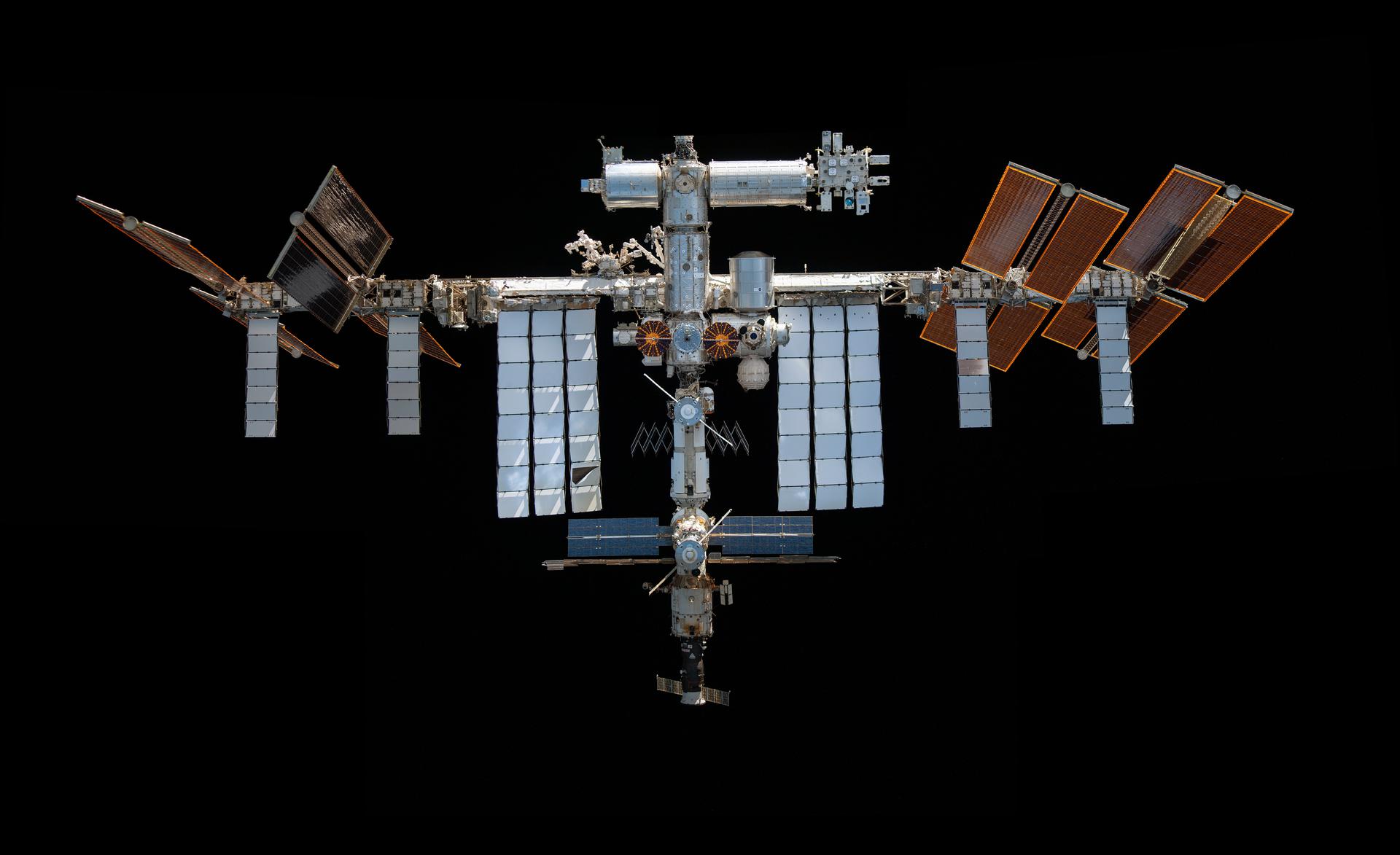
Massive radiators. In this photo[0], all of the light gray panels are thermal radiators. Note how they are nearly as large as the solar panels, which gives you an idea about the scale needed to radiate away 3-12 people's worth of heat (~1200 watts) + the heat generated by equipment.
[0] https://images-assets.nasa.gov/image/jsc2021e064215_alt/jsc2...
The ISS is designed to emit 126kW of heat radiation between the active cooking systems and the solar array cooling system.
I agree, all the good papers definitely talk about custom designed radiators being used on the dark sides of data center in space.
Let me google that for you.
https://en.wikipedia.org/wiki/External_Active_Thermal_Contro...
The ISS has giant heat sinks[1]. Those heat sinks are necessary for just the modest heat generated on the ISS, and should give an idea of what a sattelite full of GPU's might require...
[1] https://en.wikipedia.org/wiki/External_Active_Thermal_Contro...
The ISS has MASSIVE radiators. Most of its volume is radiator. 900 cubic meters of space 2500 square meters of radiator.
- [deleted]
The TL;DR is they radiate it into space via large, high surface area arms that stick out of the station.
The equation has a ^4 to the temperature. If you raise the temperature of your radiator by ~50 degrees you double its emission capacity. This is well within the range of specialised phase change compressors, aka fancy air conditioning pumps.
Next up in the equation is surface emissivity which we’ve got a lot of experience in the automotive sector.
And finally surface area, once again, getting quite good here with nanotechnology.
Yes he’s distracting, no it’s not as impossible as many people think.
> And finally surface area, once again, getting quite good here with nanotechnology.
So your hot thing is radiating directly onto the next hot thing over, the one that also needs to cool down?
This makes zero sense.
> Next up in the equation is surface emissivity which we’ve got a lot of experience in the automotive sector.
My car doesn't spend too much time driving in vacuum, does yours?
Engine bays have a lot of design go into where to keep heat and where to get rid of it. You can look up thermal coatings and ceramics etc.
Sure and it all routes to dump the heat to...where again? A vacuum? Or to a radiator with a fan with some kind of cooler fluid/gas from the environment constantly flowing through it?
Seems like quite a massive difference to ignore.
Let's just hope the person you are responding to isn't Elon Musk!
It will be the communications, not the compute part.
A glaring lack of oceans to boil
One man able to put a data center worth of mass in orbit is one man able to crash a datacenter worth of mass into Earth anywhere he wants.
Not a given. Re enter the atmosphere. Sure. Avoid vaporization? Much harder problem.
There is some evidence to suggest that spacex knows how to reenter an object without burning it up.
The engineering overlap between between a small object designed for reentry and a flying (crashing...) warehouse is not a circle.
Once upon a time there was a bonkers "rods from god" mass bomb idea, but that didn't work either.
Sometimes without even meaning to:
https://www.cbc.ca/news/canada/saskatoon/spacex-cbc-debris-s...
Fucking thank you. The number of people who take this at face value despite the unavoidable thermodynamic elephant in the room is too damn high.
There are several companies working on this, and the first generation tech is already proven, working in space on the ISS. Even Paul G is on board. https://x.com/paulg/status/2009686627506065779?s=20
https://xcancel.com/paulg/status/2009704615508586811#m for those who don't partake.
I liked one comment someone made: if it's just about dodging regulation, then put the data centers on container ships. At any given time, there are thousands of them sailing in international waters, and I'm sure their operators would love to gain that business.
That being said, space would be a good place to move heat around with Peltier elements. A lot of the criticisms revolve around the substantial amount of coolant plumbing that will be needed, but that may not necessarily be what SpaceX has in mind.