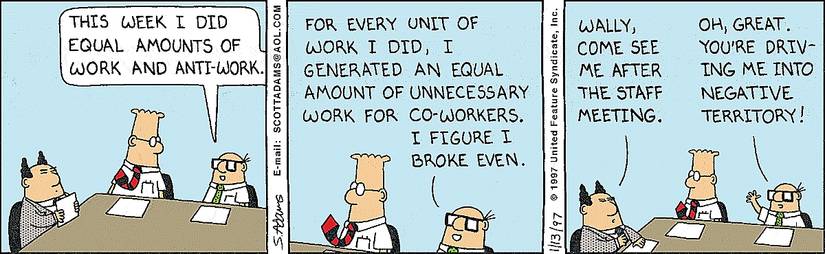
Scott Adams died today. I want to acknowledge something complicated.
He always felt culturally like family to me. His peaks—the biting humor about corporate absurdity, the writing on systems thinking and compounding habits, the clarity about the gap between what organizations say and what they do—unquestionably made me healthier, happier, and wealthier. If you worked in tech in the 90s and 2000s, Dilbert was a shared language for everything broken about corporate life.
His views, always unapologetic, became more strident over time and pushed everyone away. That also felt like family.
You don’t choose family, and you don’t get to edit out the parts that shaped you before you understood what was happening. The racism and the provocations were always there, maybe, just quieter. The 2023 comments that ended Dilbert’s newspaper run were unambiguous.
For Scott, like family, I’m a better person for the contribution. I hope I can represent the good things: the humor, the clarity of thought, the compounding good habits with health and money. I can avoid the ugliness—the racism, the grievance, the need to be right at any cost.
Taking inventory is harder than eulogizing or denouncing. But it’s more honest.
> He always felt culturally like family to me. His peaks—the biting humor about corporate absurdity, the writing on systems thinking and compounding habits, the clarity about the gap between what organizations say and what they do—unquestionably made me healthier, happier, and wealthier. If you worked in tech in the 90s and 2000s, Dilbert was a shared language for everything broken about corporate life.
Same to me when it comes his comics. There is an ugly part I did not like about Scott Adams but, that doesn't mean I will like his work (Dilbert) less. I have to admit it felt disappointing to find out about his vitriol online. Best wishes to his family and rest in peace for Scott. alway
Learning to appreciate someone's art while disagreeing with their politics is a rite of passage in the age of the internet.
There are a few artists whose output I can't even enjoy any more because their vitriol became so out of control that I couldn't see their work without thinking of their awfulness, though. (Note: I'm not talking about Scott Adams. I'm honestly not that familiar with his later life social media)
> There are a few artists whose output I can't even enjoy any more because their vitriol became so out of control that I couldn't see their work without thinking of their awfulness, though.
Thank you for at least acknowledging this. It's valid to appreciate someone's art while disagreeing with their behavior, but it's also valid if someone's behavior sours you on their art and makes it difficult to appreciate what they've accomplished - especially if you start to recognize some of their inner ugliness in their artistic endeavors.
Personally, I found that I connected with his early work a lot more than his latter work, as I found Dlibert's "nerd slice of life" arc a lot more compelling than his "Office microaggression of the week" arc. Scott revealing his inner ugliness did not make me eager to return, but I still keep a well-worn Dlibert mouse pad on my desk that my Dad gave me as a teenager; the one that says "Technology: No place for whimps."
Wherever Scott is now, I hope he's found peace.
EDIT: A few strips that live rent-free in my head.
- https://www.americanscientist.org/article/the-quest-for-randomness - https://www.reddit.com/r/reddit.com/comments/hzws/dilbert_condescending_unix_user/ - https://www.facebook.com/groups/423326463636282/posts/581619887806938/ (The Optimist vs The Pessimist)There’s a mean-spiritedness to even many of the early strips that, at the time, I thought was part of the gag - a sort of self-knowing nod to and mockery of the mean parts of office and engineering culture. In the spirit of ‘laughing with not laughing at’.
I’m not sure if Adams’ later real-life self-superiority and mean spiritedness evolved from that over time, or if he was always like that inside and we just didn’t see it, but I find myself unable to laugh with the strips in the same way now nevertheless.
There’s also a lot of artistic creepers, which predate the internet but the internet shone a light on their creepiness.
I would, for instance, watch The Ninth Gate a couple times a year if Polanski hadn’t directed it, or had directed it post jail instead of hiding from justice for 25 years. Instead I watch it about twice a decade. Luke Beson is almost as problematic, and I have a hard time reconciling just how brilliant Gary Oldman is as Stansfield with how creepy the overall tone is, especially the European cut. I enjoyed that movie when I was young and had seen the American version. Trying to show it to other people (especially the Leon version) and seeing their less enthusiastic reactions made me see the balance of that story less affectionately. As well as seeing it through the lens of an adult responsible for children instead of being the child. Now I watch The Fifth Element and that’s about it.
Read some interviews with Spielberg and Lucas about how they wanted the Marion character to act and the age they originally wanted. It's not pretty at all. I'm not sure who convinced them to follow a different path, but Raiders of the Lost Ark would have been quite a different film if they had followed through with some of the ideas they were spitballing.
Interesting. I showed my right leaning 83 year old mom the full version of Leon last year, she loved it.
…what’s wrong with Leon?
The long cut implies reciprocation of the girl's crush and that casts further shade on Leon's backstory.
I watched the director’s cut again last week, and I don’t see this at all. The Leon character explicitly refuses Mathilda’s… well they’re not even propositions are they.
It turns out that Jean Reno refused to film the scenes as Besson wanted them to be.
Ok. I'm not convinced at this point, because I don't know how Besson allegedly wanted the scenes to be filmed. And that isn't to say I approve of Luc Besson's choices in his personal life — I find the idea of a romance between a 32 year old and a 15 year old unacceptable. Whether there are parallels between his private life and his artistic expression, I am unwilling to speculate on.
> Luke Beson
Luc Besson.
Dudes who have children with 16 year old girls don't get their name spelled right.
The expectation that artists be "good people" always baffles me. Anyone who becomes a great artist has: 1)High levels of narcissism required to think the world needs to hear "your vision. 2) High levels of sociopathy to thrive in a snake pit like the art world or Hollywood. It's even stranger than if someone expected CEOs to be good people (which we don't).
I refuse to accept that a genius in their field cannot be a decent human being. If that makes me naive, so be it.
The difference is between "can be" and "are".
They can, but they're competing with assholes, you can figure out the odds.
Like there's an Olympics where everyone's on drugs but a few good folks decide to compete clean.
Want to win fair? Sure, same here. Now here come the whispers, you can just ignore them, sure, but now your girlfriend's pregnant and your bank account is looking a little thin. Good luck.
Keanu Reeves, Dolly Parton, Weird Al Yankovic, Bryan Cranston… By all accounts I ever found, they’ve always been described as genuinely nice human beings.
I don't think I've ever heard anyone describe Keanu Reaves as a "great artist". Quite the opposite in fact. Most charitably, he's a decent character actor who does really well in certain roles that suit him well, but outside of those, he is not a great actor. He also allegedly plays bass in a band decently well, though again is no world-class master of the instrument.
But yeah, he's generally acknowledged as a really nice guy, and also easy to work with.
Weird Al Yankovic, too, is not generally considered a "great artist". A funny musician who made a career making silly parody songs a few decades ago, sure, but that's not what I'd call a "great artist". Again, not to denigrate his work; it was pretty funny stuff as I recall, but nothing super-amazing.
By contrast, people who are generally considered the very top of their profession frequently have serious personality problems. Kevin Spacey was considered one of the best actors in Hollywood, and look what happened to him. Tom Cruise is generally considered one of the most talented actors of all time, and while he's amazing on-screen, he's a certifiable crackpot and mouthpiece for a dangerous cult. Klaus Kinski was also an extremely talented actor, and also extremely mentally ill and unstable.
I notice you skipped two of the names, including Dolly Parton, which I included specifically for nitpickers.
And you’re treating Al as a has-been, but his latest album was number one in the US charts.
What exactly makes a “great artist” then? Surely that’s subjective, and popularity isn’t the only metric. We’re talking “great”, not simply “famous”.
But alright, take your pick:
https://www.buzzfeed.com/hannahdobro/nicest-celebs-people-ha...
https://www.quora.com/What-famous-rock-musicians-are-genuine...
https://www.reddit.com/r/popheads/comments/s4rrug/artists_th...
Plenty of names there who are “generally considered the very top of their profession”, and bigger than the ones you picked.
I skipped Dolly because I honestly don't know enough about country music to know if she's a "great artist" or merely "famous over a long time". Same for the other guy: I'm just not familiar. But I called out your choice of Keanu because it's really well-known that he is not a great actor, and he probably agrees. But it's great that he made a good career for himself anyway; as I said, he does well in certain roles that fit him well. I don't consider myself the top 1% in my profession either.
Of course, I guess this could easily veer off into a discussion about what qualifies as "great artist". Does a top-selling musician/singer who has limited range or uses autotune count, or does someone with amazing technical ability but little commercial success not count? Does a "wooden" actor qualify as a "greater artist" if they've grossed higher than Daniel Day Lewis?
Seems like quite some assumptions are being made there. Can't work be done for intrinsic reasons? Can't artists (creators more generally) be insular or even reclusive?
I can't agree with that. While unwavering determination is definitely necessary to overcome lack of success, there are other ways to achieve that.
And as was once put to me, the reason that some artists are not appreciated until after their death isn't just a matter of not meeting your heroes, but because they understood something about the present moment that the public was not yet prepared to reflect upon. That we appreciate them in retrospect because they tell us something we are not yet ready to hear. That requires a degree of empathy for humanity that is not well represented in a strictly narcissistic diagnosis.
I'd add Star Wars to the mix, to be honest - at least the early movies. There's nothing I know of implicating George Lucas to be a sex pest like the other examples you mentioned... but Leia's slave costume is something giving off pretty bad vibes from today's viewpoint.
>but Leia's slave costume is something giving off pretty bad vibes from today's viewpoint.
It's less revealing than a bikini. It was tame enough for the 1970s and from today's viewpoint it's practically stodgy.
Nitpick: it was tame enough for the 1980s. Return of the Jedi came out in 1983.
The outfit she's forced into by Jabba? And then she kills him?
I've never understood why Jabba, a male Hutt, would enjoy seeing a female of a completely different species in a revealing outfit.
The real answer is because it's a pulp sci-fi movie and Jabba is a gross evil slug monster and him having Leia chained up like that just shows how depraved and dangerous he is. Also Carrie Fisher looks really hot in that outfit and most of the audience is likely to be adolescent boys and men.
The funny answer is.and in a universe in which it's common for alien species to intermingle, and where humans (being the Imperial species) are particularly common, being a "humanophile" might be a kink, the galactic equivalent to being a furry or "monster fucker" in our world.
It's not even a given that Jabba has her in that outfit because he finds it attractive. It could just as well be to titillate human guests or a pure power play.
Fair, although I think in Doylist terms it isn't that deep, especially when we're considering George Lucas. It's a common enough villain trope.
But Jabba did give her a good lick, so it seems like there's something he liked.
> Also Carrie Fisher looks really hot in that outfit and most of the audience is likely to be adolescent boys and men.
Well said. It feels really weird to have to defend this in this day and age.
It's ok for a hot actress to be dressed in a skimpy outfit. It was a big deal for our young selves when we watched her. Leia also ends up kicking butt (or kicking Hutt) and it's not like she's underdressed or incompetent in the movies.
This is driving me nuts, people making a big deal out of the slave Leia costume. The only person who had a right to complain was Carrie Fisher -- and she did, because it was an uncomfortable costume.
It's ok to have sexy accesses in sexy outfits. It's not ok if those are the only roles they get, but this wasn't the case.
You're going to struggle with humans shaving and prostituting orangutans, having sex with horses and dogs, etc. then.
As do the majority of people. Still, it happens :/
Thanks, you successfully ruined my day. /s
Jabba doesn't exist. The writers and directors exist.
George Lucas does *not* have a reputation as an amazing or fantastic director (like Roman Polanski etc.). In fact, quite the opposite: his Star Wars prequels have some of the worst direction I've ever seen. His first three SW movies were great, but they were very much team efforts, and in the first one, his wife heavily edited it to make it come out so well. The other two weren't even directed by George. George is (was?) a brilliant ideas person: he had a great vision for his movies, and picked some great people to work with (esp. in FX), but he sucked at actual execution and working with actors and script-writing and all that stuff. His best legacy, aside from the first Star Wars, is really his FX company, Industrial Light & Magic, not his work as director.
Leia's slave costume was nothing awful, was perfectly acceptable in 1983, and shows much less skin than a bikini, and was forced on her by an evil and ruthless gang boss who liked to eat his slaves at times, or feed them to his monsters.
> but Leia's slave costume is something giving off pretty bad vibes from today's viewpoint.
No, it doesn't give bad vibes. It was a sexy actress wearing a skimpy outfit for a couple of scenes in the whole goddamn trilogy! And she kicked butt.
Repeat after me: sexy scenes in movies are ok. And young Carrie Fisher was hot, and that was also ok. I was half in love with her when I first watched Star Wars.
Now, you can ask why Mark Hamill or Harrison Ford weren't put in skimpy outfits and whether it was more often women who got those scenes, and that'd be pertinent. But this doesn't give slave Leia a bad vibe.
It's OK if those scenes had sexy vibes. Sexy vibes aren't bad. This didn't define Leia either, she was mostly competent and kicked imperial butt.
I'm glad you brought up "in the age of the internet" because there's a part of "separate the art from the artist" that I don't see discussed enough:
In the internet age, simply consuming an artists media funds the artist. Get as philosophical as you'd like while separating the art from the artist, but if they're still alive you're still basically saying "look you're a piece of shit but here's a couple of bucks anyways".
People consume media without paying anyone. The internet is kinda famous for it.
That's a pretty lazy analysis. As an easy counterpoint, no one pays to look at Facebook or Instagram posts, but both Meta and (at least some) individual influencers are able to run profitable businesses based on that media consumption (and you could say the same of some bloggers in the late 00s/early 10s, for that matter). More speculatively, I think there is also an argument to be made that even gratis media consumption gives cultural weight to a work which is then available for monetization, especially in this age of tentpole franchises and granularly tracked personal behavior.
Influencers are, by definition, advertisers - and a particularly insidious, ugly bunch at that.
If we go by the vibe of this thread, it's yet another reason to avoid social media. You wouldn't want to reward people like this.
As for the broader topic, this segues into the worryingly popular fallacy of excluded middle. Just because you're not against something, doesn't mean you're supporting it. Being neutral, ambivalent, or plain old just not giving a fuck about a whole class of issues, is a perfectly legitimate place to be in. In fact, that's everyone's default position for most things, because humans have limited mental capacity - we can't have calculated views on every single thing in the world all the time.
Yup, for every person who takes pride in being a strong influencer, they depend on a number of people who take pride in being highly influenced.
>even gratis media consumption gives cultural weight to a work which is then available for monetization
At a certain point you're just making the argument that any lack of action directly opposing something is "allowing it to thrive", making anyone directly responsible for everything.
Not technically wrong, but at a certain point there has to be a cutoff. Can you really hold yourself responsible for enjoying a movie which is problematic because one of the batteries in one of the cameras used to produce it was bought from a guy who once bought a waffle from a KKK bake sale? The "problematic-ness" is there, no doubt, but how much can you orient your actions towards not-benefiting something you disapprove of before it disables you from actually finding and spreading things you actually do like?
I don't find it fair, nor in good faith to claim my argument is lazy. By downloading the media of the artists who's behavior your find abhorrent, but who's art you enjoy (and you can separate the art from the artists), you can assure yourself to some degree that they are not receiving monetary gain. People who were interested in the Harry Potter game (but didn't want the author to finance) simply pirated the game. Roman Polanski, R Kelly, and many others artists are exploited in this fashion.
I do agree that the consumption of that media could very easily increase its cultural strength.
Even in your influencer example, there are ways to bring less traffic/ad views to that content while allowing some ability to consume. example here: https://libredirect.github.io/
It's true, piracy does get around the whole monetary side of the equation.
Eyeballs increase ad revenue, just because you're not paying money doesn't mean the artist isn't making money.
> Eyeballs increase ad revenue
If you're blocking ads, I think this is usually false. (But I would appreciate a correction if I'm wrong, or more detail if it's complicated.)
In addition to the two replies below, which are both accurate, most people don't block any ads.
You still increase their algorithmic reach by viewing and interacting with their content. It really is voting with your eyeballs: whether you like or hate the content, if you have it on your screen, the creators benefit.
I disagree: network effects are still present even if you block ads. You tell your friends about it, they tell their friends, etc. Only a small fraction of people bother to block ads (or even know about ad-blocking), so the loss in ad revenue to those people is offset by the gain from their friends seeing the ads.
> but you're still basically saying "look you're a piece of shit but here's a couple of bucks anyways".
Is it ethical to buy Dilbert books now that Adams is dead and the money's not going to him?
If you (the royal you) thought it was unethical to buy a Dilbert book because the person who stood to make something like $4 off of it had some views you disagree with, you are a broken person. Even if Adams agreed with every single opinion you had, it's a statistical certainty that a dozen people who also make money off that book have views you find reprehensible.
> you are a broken person
On the contrary, I think folks that always try to find some sort of hypocrisy in how folks choose to not spend their money are broken.
It seems too cynical by half, and completely discards any sort of relative morality to one's purchasing decisions. I have also long suspected that there is a selfish motivation to it - as if to assuage your (again, the royal your) own morality about how you choose to spend your own money, you need to tear down other people's choices.
My chief complaint is not only that it's spitting into a headwind during a rainstorm, but also just the performative nature of it. Someone enjoys Adams' (Adams's?) work, presumably for years or even decades. He says something gross. That person then, in order to deprive this multi-millionaire of a few dollars, not only deprives themselves of something they ostensibly enjoy[ed], but also has to turn it into a moral or ethical question so they can either feel better about it themselves, or feel superior to people who a) don't really care what Adams said or did, or b) care but are capable of separating the art from the artist.
It's the same kind of performative virtue signaling that led someone at the New York Times to call him racist twice in the first two sentences of his own obituary.
In fact, some of every dollar you spend _must_ go to people you would find reprehensible if only you knew them better. Bought a Slurpee at 7-11? There's almost certainly someone in that corporation who will share ever-so-slightly in the revenue your $0.98 of sugar water brought in.
Ignore is not only bliss, but necessary.
Adding onto this, we all pay some forms of taxes one way or other and those taxes are sometimes used by govts to then either be lost in corruption or scandals or the govt itself spends it on something you might not appreciate if you know the full context of details (especially when they pertain to war)
> Ignore is not only bliss, but necessary.
It honestly depends on the time, if we as a society wants change, some amount of uncomfort is needed to better shape it for the needs/affordability of the average person but also a lot of people don't want to face that uncomfort so they wish to be ignorant partially being the reason that some of the issues are able to persist even in a democratic system
No ethical consumption under capitalism and all that, but I'm pretty sure giving money to Scott Adams is much more optional than paying taxes.
> under capitalism
Not capitalism but rather in any globalized and industrialized reality I would think. Anything beyond cottage production and you very rapidly lose the ability to propagate blame.
I think home made cottage production of tech (similar to Open source) might be an interesting proposition though. Like we as a community should support small tech more favourably than big tech and I think in many cases small tech is even more price competitive (while remaining sensibly and not burning/having VC money of course) as compared to large big tech which sometimes might be profitable in short term but they lock in.
Everything combined, I feel like its the time for a movement/ genuine support towards indie web or small tech (passionate people making software that they themselves want/wanted)
I'm shocked at how much the term "racism" is coming up. I followed him on Twitter and watched some of his YouTube and I didn't see any racist content. In fact, he did not align with the racist rhetoric and slogans which came out around COVID, that's why he was slandered as racist (ironically). He was just defending his own race. Everyone is entitled to defend their own race and culture if done respectfully and without fanaticism; which was the case here.
It's important to note that the specific comments the NYT are referencing is when he was discussing a survey in which only 53% of black people surveyed agreed with the statement "It is okay to be white." He started discussing what happens to a society when nearly half of one race can't bring themselves to say it's okay to be a member of another race.
There are plenty of podcasts where plenty of people say truly racist things. Saying "47% of black people saying it's not okay to be white is a problem" is not one of them.
> also has to turn it into a moral or ethical question so they can either feel better about it themselves,
You phrased this as an either-or thing, so I am actually genuinely curious....what exactly is wrong with this attitude?
We as people do a lot of things in our lives that probably don't make a difference, but that makes us feel better as individuals. Genuinely, what's the harm in cutting something out of your life because it makes you feel better?
I don't have any problem with not giving Adams just because you don't like him. Even if I think it's a bit silly, it's certainly your right, and while I would rather enjoy art I enjoy regardless of the artist's beliefs, not everyone feels that way and that's fine. What bothers me is the performative nature of it, having to tell everyone about it to let them know how good of a person you are, and acting like people with a different viewpoint are somehow lesser or worse.
Just look at this thread, several comments about "oh yeah that's what people without morals always say." As if whether someone spends $10 on an old book of Dilbert comics has far-reaching moral implications.
> What bothers me is the performative nature of it
I always find it funny how these sorts of things always seem to roll one way. You can be supportive of him all you like, but if you're going to distance yourself, do it quietly - preferably silently - and please don't say anything that might cause anyone to feel bad about it.
I will admit that I haven't read Dilbert regularly since the early 00's, and certainly not since Adams revealed his uglier side - but that has more to do with me finding out about and preferring Achewood's Roast Beef as my comic surrogate computer nerd.
- [deleted]
>Adams' (Adams's?)
I had to look it up as well: https://en.wikipedia.org/wiki/Saxon_genitive
Your link just redirects. I think the section linked below is better. I was surprised to learn that there's at least some amount of disagreement on the details depending on the context.
https://en.wikipedia.org/wiki/Apostrophe#Singular_nouns_endi...
The same page also covers the broader subject more generally.
https://en.wikipedia.org/wiki/Apostrophe#Possessive_apostrop...
> One would therefore say "I drank the glass's contents" to indicate drinking from one glass, but "I drank the glasses' contents" after also drinking from another glass.
Every time I stop to appreciate these details that I never really have to think about I feel sorry for those forced to pick up English as a second language. Formal latin should have remained the language of academics and international trade. We really screwed up.
>Formal latin should have remained the language of academics and international trade. We really screwed up.
I think if formal Latin was really that great a language, it would have endured much longer. Latin is a horribly complicated language, and this is probably a big reason why "vulgar Latin" came about, and why Latin-influenced languages evolved from it (Spanish, French, Portuguese, etc.), yet were neither actual Latin themselves, nor as complicated.
There's a good reason English is so popular these days, and it's not just US dominance. English is a really easy language to learn poorly. It's hard to get all the little details right (like this apostrophe stuff), especially for formal writing, and it's hard to really master it, but it's really easy to learn it at a basic level and become decently conversational with it. You'll make lots of mistakes at this level, but it doesn't matter because with the way the language works, listeners will still understand you just fine. It's not like highly inflected languages where conjugating something incorrectly suddenly changes the meaning completely.
A complicated language like formal Latin makes sense if you want your language to be more like a rigid technical specification: it leaves much less room for ambiguity. But this is not at all easy for speakers of other languages to learn well enough as a 2nd language for international trade.
I sort of have to admire the kind of person that comes right out with "I have no firm principles or beliefs, and nobody else should either". That's certainly an ethos, I suppose.
Because yeah, if you can't imagine ever genuinely standing up for anything, of course the idea is gonna feel fake and embarrassing.
People genuinely feel his behavior sucked, dude, and it's not "performative" to say so, it's normal human social behavior. Shaming and scorn are powerful tools and we use them to set norms.
So no, nobody cares if Scott Adams doesn't get $4 and has a sad. People care a lot about making it clear that egregious and ugly beliefs will be met with scorn. If that makes you feel bad, well, good. That's the point.
Nailed it. A notable behavior of people with weak morals / no principles is to loudly proclaim that other people with principles are "performative" or "virtue signaling".
And a notable behavior of performative virtue signaling bores is saying that anyone who doesn't share in the performance (even if they agree with them in principle) have weak morals and no principles.
Well then! I guess now we all know whose bread is buttered on which side.
I'd love to have a response to this but for the life of me I have no idea what you're trying to say.
It's funny to end a comment with "That's the point" when you so egregiously missed my point that I have to believe it's intentional and you're approaching this entire discussion in bad faith political hackery. Have a good day, but I doubt it.
"You are a broken person" is not an appropriate response for someone engaging in a personal boycott. This is verbiage of flamebait and it really doesn't belong here.
"Ethical" is the wrong lens to see it through. I have only so much money to spend on art. I'd rather use it on something I wholeheartedly like. Ideally, something that wouldn't exist unless I supported it (art buyers, even if we are artists outselves, should not be "gilding the lily" and heap money on artists who don't need it).
Good point, retailers typically get 50% of the purchase price, which means that they're getting as much as the author/printer/editor/marketer/etc. all combined. So perhaps if you bought the book from a bookstore you wanted to support (assuming they would carry it), that could outweigh the impact to the author.
We are really chartering into utilitarian line of thinking here.
Nothing wrong with that and I may be overthinking but utilitarian line of thinking is the reason why a lot of issues actually happen because Politicians might promise something on an utilitarian premise where there real premise might be unknown.
Morals are certainly in question as well and where does one stop in the utilitarian line of thinking
But I overall agree with your statement and I wish to expand on it that if we are thinking about offsetting, one of the ideas can be to keep on buying even books written by many authors, overall aggregate can be net positive impact so perhaps we can treat it as a bank of sorts from which we can withdraw some impact.
> Politicians might promise something on an utilitarian premise where there real premise might be unknown.
At the risk of drifting off topic, what does it matter if you agree with the policy? If I want my member of Congress to vote yes on a particular issue, and they will vote yes, does it matter to me what their motives are?
Ethical? I'd say it would be fine.
Tolerable? I couldn't enjoy the books. It's like when I found out about the Breendoggle and tossed all my MZB books in the recycling bin.
Still depends on where the money ultimately goes.
As I once noted to a homeopath regarding their extensive selection of impossibly diluted water remedies, by their own dictum, it's all toilet water.
That makes a certain kind of sense.
Then again looking at the table, laptop, and protein drink in front of me, I know that many people were involved in making and shipping them. Some were quite possibly rapists, racists and/or worse.
And I don't find myself caring at all.
This is something special about art, isn't it?
That’s interesting analogy! With art, you re receiving something that’s not physically consumed but informs you or even changes your mind - depends how that art works for you.
"Can art be separated from the artist?" is an age-old debate.
> There are a few artists whose output I can't even enjoy any more because their vitriol became so out of control that I couldn't see their work without thinking of their awfulness, though.
I think this is common. Everyone separates art from the artist based on their own personal measurements on 1) how much they liked the art and 2) how much they dislike the artist's actions/beliefs. I'm sure a lot of people lambasting the GP for not completely rejecting Dilbert due to its creator still listen to Michael Jackson, or play Blizzard games, or watch UFC. There are musicians I listen to who have been accused of SA, but there are musicians I enjoyed but stop listening to because I found out they were neo-Nazis (not in the Bluesky sense, but in the "swastika tattoo" sense).
I was never a Dilbert fan, but know it spoke to people like the GP commenter and completely understand why they'd be conflicted.
- [deleted]
Meh. I liked Dilbert and it was a part of my childhood. I don't watch it anymore. Much like I no longer listen to Kanye.
There's enough good content out there that I can selectively disregard content from individuals who have gone to great lengths to make their worst opinions known. It doesn't mean their content was bad, it just means that juice isn't worth the squeeze.
- [deleted]
- [deleted]
Well, it depends. I admit (at risk of cancellation maybe?) that I check in on Stonetoss from time to time, and sometimes I laugh at it. He's made some genuinely funny non-political comics. Also some which are so terribly over the top rihht wing that its fun in a Ben Garrison/Jack Chick kind of way. Very rarely, he even makes a funny political point I sort of agree with (his politics, while messed up, don't map neatly on to the political spectrum, he's not a fan of Trump for instance).
But adblock stays on, thank you. He can make money on his crypto grifting, or whatever it is he does.
But there are others, whose coming out as right wingers are a lot more saddening. First and foremost of these would be Tom "Geowizard" Davies, the guy most responsible for popularizing geoguessr, the inventor of the straight line mission, and a seemingly very wholesome geography lover. Not only did he come out as supporting Nigel Farage recently, but one of his dreamy bedroom pop songs apparently is about the great replacement theory?! I even bought that album! And I didn't even notice the lyrics, because the idea that that would be what he meant was so far out left field as they say. But yeah, he apparently thinks the white race is dying out?! What the hell, man? "We are the last ones in a very long line"? No, Tom, we objectively are not, whoever you include in "we"!
Somehow, trollish assholes like Adams are easier to accept than that.
IMO Dilbert was always at its best when it focused more on absurdity, and less on rage, cynicism, or ego. I still occasionally think about Dogbert's airliners that can't handle direct sunlight, the RNG troll that kept repeating "Nine", Wally's minty-fresh toothpaste-saturated shirt, and Asok's misadventures.
I do think there was another formula he gravitated towards, though. Maybe one in every four strips, it seemed to me like he would have a canonically "stupid" character present a popular belief or a common behavior, and then have his author self-insert character dunk on them... And that was it, that was the entire comic. Those strips weren't very witty or funny to me, they just felt like contrived fantasies about putting down an opponent.
Once I noticed that, it became harder to enjoy the rest of his comics. And easier to imagine how he might have fallen down the grievance politics rabbit hole.
After hearing his vitriol over the years I do see his comics and writing very differently now. As someone else said, he views everyone as idiots or below him, and needs an out group to target. Dilbert read in that light just seems hateful more than insightful or relatable. I never plan on reading any Scott Adams material for the rest of my life or introducing anyone else to it.
[flagged]
I've always been a Dilbert fan, didn't get to any of his books until later. I think Scott was someone unafraid to share his thoughts, unfiltered.
They were valuable to me because it gave me perspective on a way of thinking I would never have considered. I disagreed with the majority, but some had the subtle beginnings of truth that helped to expand my world view.
I'm grateful he was part of the world, and will miss his comedy.
> The racism and the provocations were always there
Were they? Can you cite an example? Because I also grew up with Dilbert, and I was never aware of it.
It's in Chapter 1 of his autobiography. He used to work at a bank in the 80s, and was turned down for a managerial or executive position (can't remember) which went to an Asian candidate. He was certain it was due to DEI (in the 80s!) and quit the corporate world to become a cartoonist.
The strip that got him dropped in 2022 featured a black character (first in the history of the cartoon) who "identifies as white".
> He was certain it was due to DEI
He was told explicitly by his boss that they weren't promoting white men.
> The strip that got him dropped in 2022 featured a black character (first in the history of the cartoon) who "identifies as white".
That wasn't what got him dropped, he did an interview with Chris Cuomo where he explained what actually happened and why: https://www.youtube.com/watch?v=U_bv1jfYYu4
> He was told explicitly by his boss that they weren't promoting white men.
This is what he claims but I find it very difficult to believe. Why would management even say such a thing and expose themselves to a lawsuit? Let alone "not promoting white men". It's preposterous.
> Why would management even say such a thing and expose themselves to a lawsuit?
For years, many organizations wrongly assumed that anti-discrimination laws didn’t protect white men. Recent Supreme Court rulings—especially Students for Fair Admissions v. Harvard—have made clear that assumption was false, prompting companies to rapidly rethink or abandon DEI programs.
Taking being passed for promotion all the way to SCOTUS is a big ask. For decades the default position was the law defends non-white/non-men against white men. In most other western countries you still can put out job ads saying basically "white men need not apply".
For much of history, laws in many countries were designed to uphold systems of privilege for white men. Segregation, discrimination, and unequal treatment were institutionalized, limiting legal protections for non-white individuals and women.
I mean, the legal discrimination against people of color throughout history has been accompanied by extreme violence and oppression. It's a brutal legacy that cannot be overstated.
Slavery and human trafficking, lynching and extrajudicial killings, Jim Crow laws, police brutality, denial of voting rights, economic exploitation, forced relocation and genocide, invasive medical practices, cultural suppression, and educational disparities... when you whinge about "decades" of legal protections for marginalized identities, I just wonder why you think you're making anywhere close to a salient or meaningful contribution to discussions of justice.
>>> For much of history, laws in many countries were designed to uphold systems of privilege for white men. Segregation, discrimination, and unequal treatment were institutionalized, limiting legal protections for non-white individuals and women.
For much of history, most countries did not have an upper class made up of white men.
And for those that did, the absolute majority of white men in these countries were not that far away from slaves.
The people who effected slavery and what not are long dead. A poor white boy of today or 30 years ago getting penalized in favor of a black lawyer's daughter achieves nothing in terms of justice.
Nearly half of my aunts and uncles saw Martin Luther King Jr speak live on TV.
Donald Trump was in college when active discrimination by the government became illegal.
Do you think that after Jim Crow was dismantled in the 60s, that all of those people who were against it, that you see in the video footage and photos violently protesting it, suddenly disappeared?
Yes, 20 year olds from the 60s are in retirement homes.
Still waiting for a good argument on penalizing one set of people who weren't born then in favour of another set of people who weren't born then is fixing any wrong done in the past.
A miserable person is a miserable person. Any affirmative action style policy gives less-miserable people a boost over more-miserable people.
How far back should we go with the eye for an eye that someone with superficially similar characteristics once took approach?
Two wrongs don't make a right.
That's not what this is.
Explain the difference, please.
Look up the origin of the word slave. Your world view is myopic.
Do you believe that the law should treat people differently based on the color of their skin? Do you believe my father-in-law, an Eastern European immigrant who fled communism, should be given disadvantages due to his being white, even though neither he nor his ancestors had anything to do with slavery in this country? Do you believe the likes of Claudine Gay, who hails from a wealthy family and grew up in the very picture of privilege, should be given advantages due to her being black?
Do you believe in punishing the son for the sins of the father? Do you believe in punishing someone who just happens to look like the sinners of the past? Do you believe that nonwhite people's ancestors did not commit the same atrocities at some point or another in history as white people's ancestors?
I'm not white, but I find ideas you espouse to be just simple racism, and nowhere close to "justice".
Your father-in-law, an Eastern European immigrant who fled communism, benefits from ongoing racialized distributions of privilege, power, and money.
So, yes, I do believe he is "cutting in line," and should have the humility to stand in solidarity with, rather than standing on the necks of, marginalized communities. Your father-in-law is not climbing out of anywhere so deep a hole as the Black and Hispanic populations on this continent. Not even close.
Even the Gulag Archipelago pales in comparison to the centuries of slavery, genocide, rape, and disenfranchisement we have visited on these peoples in order to accrue the wealth that your father-in-law now has the privilege to work for.
You're still talking promoting group A at the cost of group B for what group C did to group D, people in groups A and B having not much to do with C and D. Even considering descendants of original group D, the benefits are overwhelmingly reaped by those affected by whatever extant systemic injustice remains the least.
Let's exchange reading lists and revisit in six months.
[flagged]
You're maintaining negligent ignorance.
You are currently standing on the shoulders of minorities to rise yourself above others.
If you are indeed honest about it, you can personally take a step back and promote anyone you want. Demanding it from others is just self-righteous and your intentions are questionable.
That Eastern European immigrant is a result of centuries of feudal slavery. The serfdom of population east of Oder meant lack of freedom of movement, mandatory free work for the lord and the clergy, great poverty and no education. Lord could decide about life and death of their serfs and killing of serf by a different noble was just resolved as part of the business with a fine/repayment. Serfs were just another commodity in lords property, the further east, the worse serfs were exploited.
Despite XIX century reforms dismissing serfdom in some regions, generational poverty of peasants kept them in serfdom like conditions up until end of WW2. And even after WW2 you could end in Ukraine with forced exports of food resulting in genocidal famine.
That Eastern European immigrant has family history of half a millennium or more in slave like conditions.
What are you talking about here. You have white men having disproportionate advantages and representation all the way up.
You are just lying.
The fact that the top 0.00001% are white men doesn't make it any easier for the bottom say 30% white men. I have no problem with whoever is in bad situation getting helped, I have a problem with a Ukrainian getting penalized compared to an Chinese because long time ago a German bought some African slaves.
The bottom has women overrepresented and non whites overrepresented.
And politically, they do not get nearly as much excuses as white men do.
The argument is not about supporting the bottom, it's about supporting groups with some correlation to being in the bottom with no regard to actually being at the bottom.
which organizations were these? Title VII of the Civil Rights Act doesn't carve out any exceptions.
It also doesn't allow for the whole affirmative action / disparate impact approach, yet that's how it got applied in practice for quite a while.
Any organization with a DEI department, which is most of them. It was pervasive.
In the 80's? In banking? Citation needed.
The book that's being referenced?
That would be circular reasoning - we know Adams' claim is true because DEI was pervasive in the 80's, and we know DEI was pervasive in the 80's because Scott Adams said so.
[dead]
Cool. How many HR departments do you believe had the Civil Rights Act as part of their onboarding in the 80s?
Well, Harvard for one. They are the one named in the suit. You can also look at the long list of amici briefs and consolidated cases.
Google is notorious for pulling this and numerous people have come forward pointing it out and the CEO of IBM was on air back in 2021 (?) pointing out that any white men who have a problem with not being promoted can essentially pound sand.
This is/was an incredibly common behavior in tech, and anyone who says otherwise is being willfully argumentative or is incredibly isolated.
Anecdotally, I have heard the exact opposite. The one thing that is in agreement is that the people promoted in management are uniformly incompetent.
> Why would management even say such a thing and expose themselves to a lawsuit?
The 1980s were not the 2020s. I can probably drop a half dozen working anecdotes from that time that would blow your mind…on all sorts of things.
I agree. I was there. There was no DEI and “not promoting white men” was not a thing.
Well, I can’t speak to that with enough confidence to say it was “not a thing”, but I never saw that sort of thing in the eighties. Although, it would not necessarily be unusual for a manager to be that blunt and open at that time without fear of lawsuits, so that part tracks as possibly true for me if there was some sort of effort within his company.
However, latter half of the 90s I was in a high enough position in a couple of organizations to experience conversation in management meetings that the hiring of diverse candidates as a preference if possible was often discussed. Although in hindsight you would probably consider it more tokenism than a concerted effort at diversity.
Just to throw my anecdote in ... In the 1980s, I met a handful of white people (on different occasions) who each complained that they needed a near perfect score on the State Police entrance exam whereas "other" people could be accepted with far lower scores.
So, these types of policies did exist at the time. But I'm sure there was a continuum of policies in effect at different institutions in that era.
Of course, to me it's perfectly plausible that Adams' boss told him they weren't promoting white men, but largely because I could see the supervisor lying to Adams simply for the purpose of not looking like the bad guy. ("Hey, I wanted to promote you, but you know how the Dems keep meddling in corporate affairs, right? My hands were tied.")
> a handful of white people (on different occasions) who each complained that they needed a near perfect score on the State Police entrance exam whereas "other" people could be accepted with far lower score
Were these people trustworthy? Because that sounds exactly like the kind of urban legend that people like to parrot, or like a pretty standard way to cope with not getting hired. I heard a bit of very similar chatter about college admissions back in the day. “Maybe I would have had a shot if I was Asian.” Etc.
> I heard a bit of very similar chatter about college admissions back in the day. “Maybe I would have had a shot if I was Asian.” Etc.
I’m not sure you can really say this was an urban legend, as there was a number of court cases regarding it (At least one from that far back) and a recent SCOTUS (2023) ruling specifically ending the capability of colleges to utilize affirmative action considerations for admissions. Not to say that every person who claimed such a thing was accurate, but it was happening.
https://en.wikipedia.org/wiki/Students_for_Fair_Admissions_v...
> Were these people trustworthy?
It was a long time ago (obviously). In general, yes, they were trustworthy, but they themselves could have been victims of misinformation--I don't really know is the short answer. But this is true for just about any bit of "news." Unless you have direct knowledge of a piece of information, you evaluate the information (and the person relating the info) and you make your best guess as to its "truth/falsity."
These days, I find it extremely difficult to trust a lot of federal "truth", so I get your overall point. :-(
I'm not disagreeing with you, but this is the exact same argument that some people use to say that racism is no longer an issue. "I've never seen racism"
What position were you in that would give you visibility into every manager's office in the country?
“Politically Correct” came out of the late 80s / early 90s era. I’m certain you saw socially insane things in the 80s. I’ve had similarly insane anecdotes of investors holding court in strip clubs dangling venture capital in front of our firm in the late 2010s. Shitty people in power will always exist.
Strippers... brothels... and /hypothetically/ I could tell one story from a well known company where a sales team got in trouble for trying to expense hookers AND blow on a business trip.
That's all post-Millennium
Back when people knew how to have fun
- [deleted]
Im not suprised.
As recently as 2024, my own fortune 50 company had a policy where manager bonuses were determined POC hiring rates.
Ive been told by recruiters that they arent hiring white men in the 2020's.
In the 2000's I was also turned down by a fortune 50 defense contractor who said they needed more women to secure better federal contracts.
People did all kinds of crazy shit at work (and everywhere else too) in the 80s before everyone lawyered up - guys would literally pinch a girl's ass, people used slurs to each other regularly (and often laughed about it), they smoked and drank all the time. A manager somewhere telling a rejected candidate straight up "sorry man but I've got to hire a <<insert minority>> this time" is not at all difficult to believe.
It was 1999 I think, I was doing a placement at a media company. One of the PAs was heavily pregnant, an old guy in the office said to her "My my Jane, your breasts are coming along nicely."
WTF!
How many times have we read about managers that explicitly tells women they won't get promoted because they are expected to get pregnant and later leave? Sometimes the conversation even get recorded on tape.
Managers being explicit raciest and sexists are not that uncommon.
My SIL, this week(!) was told by her supervisor that if she tries to apply for another team and doesn't get that job, she'll be set back in her career progression in her team. Asshole managers are everywhere.
- [deleted]
It's because the boss was lying to him
Both of these rebuttals seem they rely on taking Adams' word for it?
If we’re talking about what he believes, I’m not sure how else you’d determine that besides listening to what he’s said.
The problem is that people are horrible narrators about their own issues/past. They like to leave out critical information.
The idea of a company in the 80's going around that they are promoting Asians to positions over white people, sounds as far fetched as finding oil in my backyard. The reverse is way more likely in that time periode.
More then likely, he was not qualified for the job. But people often have a hard time accepting this, and feel entitled for position. Often by virtue of working somewhere longer. When passed over for promotion, then they create narratives its not themselves who is the issue, but it must be somebody else their fault.
So when you 20, 30, 40 years later tell the story, are you going to say "well, i was not qualified" or are you going to double down that you got passed over for a promotion, because "somebody had it out for me", or as "DEI hire" as that was the trending topic in conservative circles. What is a little lie to make yourself feel better, and have the world perceive you as the victim of horrible DEI hiring practices ... in the 80s!!!
If people think racism is rampaging today, they really did not live in the 80's... So yea, if it smell funny, you know there is bull.... involved.
If you assume Adams is lying, that’s your call. But if the question is what he believes happened, the obvious evidence is his own account. I’ve listened to him for years and find it credible. Also, for a long time there was a strong taboo against white men complaining about discrimination, which makes it easy to imagine it never happened—regardless of whether it did.
Adams was insanely narcissistic. Inventing reverse racism to avoid confronting his own short comings is completely on brand.
> Adams was insanely narcissistic.
A claim based on what?
That time he showed up on metafilter with a sock puppet and talked about himself in the third person.
https://www.metafilter.com/102472/How-to-Get-a-Real-Educatio...
"As far as Adams' ego goes, maybe you don't understand what a writer does for a living. No one writes unless he believes that what he writes will be interesting to someone. Everyone on this page is talking about him, researching him, and obsessing about him. His job is to be interesting, not loved. As someone mentioned, he has a certified genius I.Q., and that's hard to hide." - Scott Adams, as plannedchaos
Using a sockpuppet account is hardly the crime of the century. If that's your worst criticism of him then he's doing very well.
> If you assume Adams is lying, that’s your call. But if the question is what he believes happened, the obvious evidence is his own account.
You can believe something with all your heart and that believe can be a lie. People are not machines.
The idea that a manager will go "hey, we are DEI hiring Asians" in the 80s in the bank sector... No offense but that is mixing modern 2020's politics and trying to transplant it to the 80's.
Fact is, you only have one source of this "truth", and have historical data that disproves this idea of DEI hires in the 80s (unless your white and male, then yes, there was a LOT of DEI hires and promotions that bypassed women and/or people of color).
And this is still happening today. But nobody wants to talk about that too much because that is considered the traditional family and god given right to the white male ;)
I am betting your a white male, that lissen to a lot of conservative podcast/twitter etc. You can prove me wrong but we both know the truth ;)
> The idea that a manager will go ‘hey, we are DEI hiring Asians’ in the 80s
No one used the term DEI in the 1980s. The language then was affirmative action or EEO, and it was very much present in corporate America, including regulated industries like banking. The terminology has changed; the existence of compliance-driven hiring and promotion pressures has not.
> You only have one source of this ‘truth’.
When the question is what someone believes happened to them, their own account is inevitably the primary source. You can argue he was mistaken or self-serving, but dismissing the account outright because it doesn’t fit your expectations isn’t evidence.
> I am betting you’re a white male
And that assumption rather neatly illustrates why, for a long time, it was socially risky for white men to even claim discrimination without having their motives or identity used to invalidate the argument.
> No one used the term DEI in the 1980s. The language then was affirmative action or EEO, and it was very much present in corporate America, including regulated industries like banking.
This is true.
What is false is a blanket "We're not hiring or promoting white men" as a result during that time period.
That was an era when lip service was given to affirmative action and literal token hires were made as window dressing .. but the fundementals scarcely changed and extremely rarely at board room and actual upper management levels for jobs that included keys to levers of power.
No one has claimed a blanket anything.
> That was an era when lip srvice was given to affirmative action and literal token hires were made as window dressing .. but the fundementals scarcely changed and extremely rarely at board room and actual upper management levels for jobs that included keys to levers of power.
This is a pipeline fact. But that doesn't mean individuals didn't try to redress the balance themselves. Just as some schoolteachers will give kids of colour higher marks to make up for the bad things that they were told happened to all of them.
> No one has claimed a blanket anything.
Scroll up:
> He was told explicitly by his boss that they weren't promoting white men.
@sanity https://news.ycombinator.com/item?id=46607980 3 hours ago
While he may have been told that (or more likely "remembered" things that way), it simply wasn't something that was commonplace in the 1980s.
Where exactly was he working that had a "no white men at the top" policy in the 1980s?
Death Row Records was founded in 1991, Bad Boy Records was founded 1993(?) and in that industry sub domain it should have been intuitively obvious to the meanest intellect that no white men would reach the top well before they (if any) joined as lowly office clerks.
There are many well-documented cases of this sort of thing happening in the 1980s and even earlier.
https://ia800108.us.archive.org/view_archive.php?archive=/24...
Note that here, Philip Morris explicitly said they used race-norming to hire minorities at the expense of people who performed better, but belong to the wrong race.
In some cases, it was court ordered: https://www.latimes.com/archives/la-xpm-1986-04-07-mn-22054-...
In this case, a test acknowledged as meritocratic caused too many minorities to be excluded, as nearly all the top performers were white. The fire department was sued, and ordered by a judge to hire at least 40% minorities -well above the applicant rate. They hired 55% minorities. Eventually SCOTUS ruled there was nothing wrong with the test - meaning for years, white applicants were discriminated against.
Here's another example, which obviously not only shows political and legal pressure to promote minorities specifically (even mentioning specific quotas!), but documents specific instances of policies that succeeded in doing so anti-meritocratically: https://www.govinfo.gov/content/pkg/GAOREPORTS-GGD-95-85/pdf...
We're not talking about what he believes, we're talking about a) why he didn't get a promotion and b) why he was dropped from syndication.
> a) why he didn't get a promotion
What evidence is there to go on that's better than his own account?
> b) why he was dropped from syndication.
That is well-understood https://www.youtube.com/watch?v=U_bv1jfYYu4
He has been proven to be an extremely unreliably narrator on multiple occasions and is prone to changing his story. I think he has always had such inclinations, but other folks kept him restrained and I’m not sure what happened there in the end.
I’m reminded that he is on the record as having initially said that he enjoyed working on the Dilbert TV show, but it was too much work and had the misfortune of being moved one of those “death” time slots. Then at some point he started baselessly claiming it was killed due to DEI.
Also, he has a very bizarre history of sockpuppeting that just raises more questions. He was called out by Metafilter for this and acted like he was playing some kind of 4D chess with them [1].
Or perhaps it was killed due to DEI but he didn't feel comfortable being honest about it at the time because there is a powerful taboo against white men claiming discrimination.
It’s really notable that post-Trump Scott Adams is the only one who is speaking truth to you here.
- [deleted]
Why wouldn't we take his word for it? We take people's word for much more serious and dangerous claims than these personal autobiographical reports.
I believe the correct statement is "believe victims"
Even if we believed that, why is one such experience an understandable trigger to turn to fascism? It is nice double standard, because those who are not white men are expected to accept similar unfairness without becoming fascists themselves.
I really really doubt his boss would have told him they weren't promoting white men. It is asking to get sued.
People get this a lot. They want a woman to fill the role or quota, or they want X attribute to shore up "representation". In South Africa people will be openly told that they will never get a promotion because of their race and sex.
I'm NOT saying that wasn't their motivation, I'm saying they would never explicitly tell anyone that it was their motivation as it is very illegal.
I directly know people who've had this said to them. South Africa has even more discriminatory laws than the US's affirmative action.
Scott Adams lived in the US his entire life.
I'm just refuting the obviously silly claim that it's impossible to have heard this. Of course it's possible, even if it's illegal.
In the US it is very likely to be a lie
In south africa it is.
Scott Adams lived in the US his entire life.
How is this racism? It's a complaint about alleged racism and a pun on corporate "Identifies as black" DEI events. He is not saying anything negative about asian candidate or black character.
Reads more like it makes fun of trans people to me.
It mocks diversity policies by presenting race as arbitrary and surface-level, rather than some deeply unchangeable thing that pervades every aspect of your being. Since diversity policies are a way to push back against judging people differently based on race (aka racism), mocking them is inherently supportive of racism.
And as the other commenter says, it also mocks trans people. By applying their language to something presented as arbitrary and surface-level.
Maybe this is a generational thing, but that first sentence is nonsensical to me. DEI wants to enshrine race differences, so mocking DEI is… racist?
It's not a generational thing. That sentence is just nonsensical.
Ibram Kendi wrote about how the only way to not be racist is to deliberately treat people differently based on their race. He was quite popular for this for a while.
But also for the DEI thing specifically, what's going on is that objecting to the implementation details is proof that you oppose the stated goal. Even if what you're doing is pointing out that the implementation is counter-productive to the stated goal. I think it might be some sort of tribalism thing.
It’s a hard thing to wrap your head around, but: the idea is that racial differences are already enshrined, by racists. if racists weren’t pushing the idea, it would hardly be an idea at all.
Try explaining to a “go back to where you belong” racists that you’re not from Africa (or from Mexico, or wherever) - you have a different ethnic background, or you’re a natural born citizen - racists don’t care about the nuance, you’re coloured and they’re bigoted, and race differences are enshrined.
So if that’s the case - if you’re just going to be lumped into the same bucket as every other (say) black person anyway - then you’re only going to make yourself weaker by dividing yourselves - you need to organize to push back against racism, and that means your natural allies are going to be all the other people that racists are racist about - and by extension, all the other people bigots are bigoted about. Now it doesn’t matter if you were born in Egypt, or in the Sudan, or in Somalia or Jamaica or Haiti or Illinois- racists all treat you as ‘black’, and it’s on that basis, that shared identity as people oppressed for being black, that you struggle for justice.
And what is justice if not redress?
Anyway the point I’m making here is, it’s not DEI that’s enshrining race - it’s racists. The reason DEI is organized along racial lines is because that’s how racism is applied by the bigots who believe in that crap.
Very much along the same lines of why “all lives matter” in response to “black lives matter” is a very deliberately racist statement - because it’s mocking the struggle of oppressed people to get justice for themselves and to defend themselves from their oppressors.
Thanks for putting in the effort with that comment. I understand what you’re saying, but it seems like a local optima problem to me: enshrining race differences in corporate policy and law may be optimal right here, right now, but it’s antithetical to the long term goal of removing racism. How can you possibly get there from here?
There's also the problem that the logical basis is "two wrongs make a right" and the factual basis is unquantified personal anecdotes and disparate impact.
You are quite correct that it is the DEI racists enshrining race in hiring policies. They should all be thrown in prison for violating civil rights law.
We have mocking police now? Police who enforce who can be mocked and who cannot?
How can I get on this list of superior humans who are above mocking, satire, parody and, ultimately, criticism?
> He was certain it was due to DEI (in the 80s!)
Why wouldn’t it have been that in that decade? The concept of DEI (whether or not it was specifically called as such) has been around at least far back as the 1980s. I think it actually goes back even to the 1960s.
This wasn't when he got dropped. He got dropped in 2016 when he said he supported Trump. In an interview on CNN shortly after this, he talks about how all of his corporate gigs dried up and newspapers tried to cancel him. He also later talked about Venture capitalists dropping him as well because of this.
"it was due to DEI (in the 80s!)"
DEI used to be known as affirmative action in those days. I see so many people try to claim that it never happened, when many of us around during this time experienced it.
"The strip that got him dropped in 2022 featured a black character (first in the history of the cartoon) who "identifies as white"."
While I don't see a problem with this, this was a fuck you to corporations and newspapers that dropped him merely because of his political opinions, an inhumane and bigoted tactic by liberals. This is one of the reasons why I always respected him. He was willing to fight for his beliefs and never backed down.
> an inhumane and bigoted tactic by liberals.
The free market is neither inhumane, bigoted or liberal in nature.
It's a big liberal thing to feign ignorance and even act shocked to hear about something they have seen with their own eyes. They will also pretend not to understand what you are saying when you are perfectly clear in your wording. I fundamentally don't understand the psychology behind it and IMO the correct response is to just treat those people with contempt.
[dead]
If you want to dig down deeper into his past, you can listen to a 2 part episode of "Behind the Bastards" https://www.youtube.com/watch?v=8nyEkHqP65c
Dilbert May 2, 2022 is provocative.
Didn't he get dropped a year after that? The quote "the best advice I would give to white people is to get the hell away from black people, just get the f*k away... because there is no fixing this" happened in 2023.
Can't argue with that, but Dilbert first appeared in 1989, and Adams publicly jumped the shark in February 2023. So May 2022 is hardly "always there".
I think you are right on the "wasn't always there" front, though perhaps the commenter making the claim has some early work in mind.
Personally, the Reddit AMAs (including sock puppets) were a pre-2023 indicator of his enKanyefication. Endorsing Donald Trump (who encompasses the stupidity and lack of self-awareness of the Dilbert antagonists) was another, though this may have been driven by a need for money/relevance.
Huh. I would have thought something like that would be in response to Rachel Dolezal, but the Wikipedia page for "Transracial (identity)" says her fifteen minutes of fame was way back in 2015.
What was it?
Provocative, yes. Can someone ELI5 for me why this is racist?
I read it as mostly anti-trans (or at the very least, anti-"you pick your pronouns").
The new hire appears to have been hired just purely because of the colour of his skin - apparently because of a diversity initiative. That strikes me as racist because it implies that they've never hired any non-white engineers due to their performance without addressing the inherent bias in the system that would only hire white engineers even when more qualified engineers of different ethnic backgrounds are available.
There's also the dig at people who wish to be known by certain pronouns/titles/names (e.g. "Ted" Cruz)
> The new hire appears to have been hired just purely because of the colour of his skin
It's explicitly stated. But isn't that the whole Dilbert schtick? The PHB is not supposed to be good. He represents the stupid side of Corporate America. And then when the black guy says "I identify as white", Corporate America doubles down on the stupidity.
"implies they've never hired..." seems to be reading an awful lot into it.
> "implies they've never hired..." seems to be reading an awful lot into it.
I believe that that was the first coloured person in the whole Dilbert strips, though I haven't checked that. I was a fan of Dilbert many years ago, but I suspect that if I re-read them that I'd be thinking of Scott Adams' later politics and looking for early signs. There's probably a lot of suspect cartoons that featured the Elbonians.
Typical DEI bullshit. They claim that DEI is critical to hire minorities, but then if you claim any one person was hired because of that policy the call you racist.
- [deleted]
The persona he presented in social media was very angry and smug. I always liked reading dilbert growing up, but it’s difficult for me to read Scott Adams comics now without the echo of his angry rants in the back of my mind.
>You don’t choose family
Right. But he's not actually your family member.
I dont disagree with your general sentiment but you are literally trying to pick your family.
At my age, he was about as close to family as you can get without being physically there. I grew up reading his comics in our newspaper while eating family breakfast. His work was a part of our family morning ritual. His work was part of pre-internet America when our channels were limited. Our thought and worldview were to some degree shaped by these limited channels.
The op didn't get to decide that Scott's work would be so important for him, or have as much influence on him as it did. There are a lot of things you don't choose, family being one of them.
Right - and he wasn't family.
Humans have a lot of trouble with realizing people aren't binary. People hate the idea that bad people can do good things.
Is that really true? Young children perhaps. IME most folks learn that people are complicated at least by adolescence once they realize their parents are imperfect.
Of course there is the ever present temptation to resort to tribalism, which is pretty binary: in or out.
For example, the general attitude shift about Elon Musk following that cave rescue incident. Before that he could do no wrong, and after that he could do no right.
I'm struggling to think of anything he did after the cave incident that could be construed as right?
I don't think this is an interpretation problem. I think he genuinely started going down a path that most of us disagree with.
If taking heroic doses of ketamine on a regular basis is wrong, I don't want to be right.
Neuralink is incredibly cool and that's just the first thing that comes to mind. You might be struggling to realise people aren't binary.
Neuralink scares the bejeesus out of me, for good reasons. But I'll grant you it could be used for good.
And no, I'm very OK with non-binary people.
He’s providing starlink for free to Iranians right now afaik.
Fair point. And he provided free coverage for a long while with Ukraine [0].
I'm tempted to speculate on reasons, but I think I'll just leave it and admit that yes, he did a good thing here.
[0] https://en.wikipedia.org/wiki/Starlink_in_the_Russian-Ukrain...
He was just better at his PR and kept his filter running. Once he hit a critical mass of money and influence, he let the mask slip.
My favorite (or perhaps most regrettable) example of this is Albert Einstein.
Obviously brilliant, but a real piece of shit when it came to women and fatherhood.
Still, I can appreciate his scientific work nonetheless.
This comment reminds me of when I talked to a few Chinese friends about their thoughts on Mao. They all acknowledged the failed policies which led to famine, yet they also admired that he basically gave Chinese people their pride back.
They related him to an uncle figure who became a mean drunk.
I used to say the same thing about Ronald Reagan -- a president who did many questionable/bad things, but he lifted the U.S. out of the doldrums we experienced in the late '70s.
Over time I've learned context about how those doldrums occurred, and more about what Reagan actually did, and the trade seems much less worthwhile. :-/
Are you talking about Iran-Contra? Because that's quaint by today's standards. Trump could do Iran-Contra on a Tuesday and people would be done talking about it by Thursday.
Nope, I knew about Iran-Contra years back. I'm thinking of the economic policy, the AIDS mishandling, the rest of the middle east shenanigans, the various military escapades, and on and on.
Ok and which of those would have been a more than 1 day news cycle if they happened today?
RE ".....Ronald Reagan -- a president who did many questionable/bad things..."
Not being in the common demographic of this site , I had to google this - as I was not aware of any ..... It educated me. It made me immedicably wonder where the current president would fit into ... since the google also had questions and claimed answers/OPINIONS too " who was worst US president etc... The current presidents situation is still being played out - obviously ...
The famine stuff I could write off as honest mistakes by a misguided but well meaning leader. Mao's role in kicking off the Cultural Revolution as part of his internal power struggle with the CCP can hardly be excused the same way, it was profoundly evil. The CCP today can recognize some of the faults with Mao, and even acknowledge that the Cultural Revolution was a disaster, but shy away from acknowledging Mao's causal role in that.
“Thus, the Communist and Cultural Revolutions represent some of the most radical attempts in human history to eliminate the advantages of the elite, and to eradicate inequality in wealth and formal education.”
I'm just glad Dilbert's creator is in the same thread as Chairman Mao
It's a shame he's not around to get really upset about it.
He'd probably be flattered, Mao was one of histories greatest influencer of minds after all.
Of nothing else, he was impressive at melting down.
I’ve met too many (mostly martial) artists who have stories of their lineage having to hide their art during Mao or a similar dark period in other parts of East Asia to see these people as an uncle. More like the kid in high school you found out is serving two consecutive life sentences and saying, yeah that tracks.
> This comment reminds me of when I talked to a few Chinese friends about their thoughts on Mao.
There has been a push under Xi's leadership to whitewash a lot of the past, especially involving Mao. As Xi has been positioning himself as a somewhat father figure of the nation. This has resulted in a revival of Mao policies, like the little red book.
So do not be surprised about uncle figure statement...
Well that’s the kicker right? Mao gave way for later leaders who lifted China out of poverty. The normalization of all this craziness is what led the USA to where it is today. Two quite different trajectories.
Not very different. In fact, both endpoints seem very similar, even though the starts were different.
If anything, the US is still far away from as bad as China.
> If anything, the US is still far away from as bad as China
That is a matter of opinion
I am unsure about social conditions within the countries ( freedom Vs. economic security -hard to compare)
But in international relations the USA has been a rouge state for many decades (e.g. tjr Gulf of Tonkin deception). The USA pretends to care about "values", but does not, it cares about it's own interests
China is plain speaking and cares, openly and transparently, about its interests
The USA has institutionalised hypocrisy. China sins her own sins in the open
The USA is much worse than China - to foreigners
> China is plain speaking and cares, openly and transparently, about its interests
Hum... Are you from the US or Europe?
The amount of propaganda circulating worldwide about how China is helping propel all developing nations into modernity with infrastructure investment is just ridiculous. (And yeah, there's half a truth in it, like all useful propaganda.)
> The USA is much worse than China - to foreigners
The USA is such a hellhole that millions want to come here, legally or otherwise.
>China is plain speaking and cares, openly and transparently, about its interests
What???????
Sounds like what some American will say in two or three years, except for the excuse about being drunk.
That's because they've been indoctrinated - Mao was a complete disaster in every way but admitting that is a step too far for the CCP. The cultural revolution was the worst thing to ever happen to Chinese cultural history and connection to the past (since destroying that was the entire aim of it). Sun Yat-Sen is a far better example of someone worth venerating as a moderniser who didn't want to destroy everything from the past.
- [deleted]
Pride made it worth it?!
It is very important to understand where the Chinese have just come from. British Imperialism and Japan's occupation were pretty much civilizational trauma events.
Opium Wars, Rape of Nanking. Things had been pretty hardcore for the Chinese for quite some time when Mao took power.
Don't forget the decades of fragmentation and civil war.
People that take power in those kinds of environments rarely trend towards genteel treatment of their political enemies in the peace that follows.
They're rarely that kind to their enablers either.
I don't think the "Down to the Countryside Movement" was what the Red Guard were expecting as their reward for supporting the revolution.
The current agitators in the West need to remember that the latitude they currently have to dissent and protest isn't likely to exist after the actual revolution.
Having married a Chinese person. Yes. Despite the massive issues with the cultural revolution and communism in general, they are taught to be aware that it was Mao who threw off imperialism. Chinese are self governing because of him. Right or wrong, that is how they feel.
I think it's possible to throw off the yoke of imperialism without then promptly dipping right into totalitarianism.
Far more Chinese think that their country is a democracy and the government serves the people than in the US.
Whether this is objectively true is another question, but from their perspective, that's what it is.
>Far more Chinese think that their country is a democracy and the government serves the people than in the US.
>Whether this is objectively true is another question, but from their perspective, that's what it is.
Correct, as a general rule, slaves think more highly of their slave owners, compared to people about their politicians/leaders who were elected by them.
( what happens behind the scenes is this: the slaves/dissidents who are rebellious are killed off by the dictator - only the most ardent supporters survive)
The average chinese netizen is approximately 100x more aware of their position in society and the propaganda being broadcast in their direction than the average american
Can buy that.
I see this so much with regard to Chinese/Russians and increasingly Americans (I know people in each camp). The point of the propaganda is just that, to make them distrust all information and fall in line by default. It makes it impossible to argue against the main narrative being broadcast because "who's to say what's true?" And frankly I'm getting real sick of it. It's not the same thing as being media literate.
This is the kind of opinion that could only issue from one of the last societies to own literal slaves.
I can hear the argument that the Chinese government serves their people better than the US gov. Not necessarily agree with it but it's worth discussing.
However I don't know by what definition of democracy a country with a unique party, with so little freedom of press, can be considered as one.
A 1 party system can still be democratic in a way. Just participation in the policymaking works differently. In China this is feedback from the public and local committees.
Also that freedom of speech is very limited is correct, and there is extensive online censorship. But that doesn't mean the government ignores what people think. Almost all domestic government policies are broadly supported by the population. And when public opposition is strong then the government is known to delay implementation or change course.
Notable examples are Covid Zero, the K Visa, and the reclassification of drug use offenses.
'Look, democratic centralism has the word democratic right there in it. How can it NOT be democratic?'
In China the participatory model works and citizens overwhelmingly approve of the outcomes (when it comes to domestic policy).
In US, which is a liberal democracy, you have outcomes like 20% satisfaction with Congress, yet >90% incumbent reelection rates.
https://en.wikipedia.org/wiki/Congressional_stagnation_in_th...
I'm not saying everything is good and democratic in China and bad in the US, but the answer is a bit more nuanced than some people here like to think.
>I can hear the argument that the Chinese government serves their people better than the US gov. Not necessarily agree with it but it's worth discussing.
Correct, as a general rule (true) slaves think more highly of their slave owners, compared to people about their politicians/leaders who were elected by them.
(what happens behind the scenes is this: the slaves/dissidents who are rebellious are killed off by the dictator - only the most ardent supporters survive)
Oh so like, what trump is attempting to do now by cutting programs to blue states and putting brown shirts on the streets to shoot anyone who disagrees in the face?
Good governance (stability, competence, responsiveness) is independent of democratic rule, and is generally what ordinary people care most about.
I don’t think so. I haven’t seen a successful example of that, not in a country are large as China.
Even the US - after independence one imperialism was replaced by another - a committee of the wealthy. It was a slow march to the democracy and universal suffrage that exists today.
Yeah, at least in China noone can vote out The Party.
> The United States is also a one-party state but, with typical American extravagance, they have two of them.
~ Julius Nyerere
China spent a century being invaded and oppressed by the outside world, culminating in a massive war against a much smaller country that killed maybe 20 million of their people and which was only won due to a huge amount of outside help.
Today, China is the first or second richest and most powerful country in the world.
That trajectory changed when Mao came into power. Maybe it could have been done better, but he's the one who did it.
The Great Chinese Famine alone, which was largely Mao's fault, killed at least that many people. https://en.wikipedia.org/wiki/Great_Chinese_Famine
That's not how it happened so talking about alternatives is conjecture and a fantasy. It's not productive here.
Unfortunately the rest of the world has no real example of that. Which is more of an issue with imperialism itself than the people trying to escape it.
This is very lightly said. You probably should have said, "without killing 70 millions".
And the USA did just that.
Them and every other country. American kids are taught how the founding fathers cast off the yoke of british imperialism. I think every country has a national origin story they drill into their citizens to justify the state.
It’s historically incorrect though.
After the 1911 Revolution imperial possessions were a few stripes of land in Shanghai.
It was mostly civil war after that until 1937, and KMT fighting the Japanese.
Then another civil war in 1945.
Mao could be viewed as unifying the country under one government, but fighting imperialism? The CCP played a small role.
They were building an imperium themselves before and after.
Might you elaborate? My slight understanding is that the 1911 Xinhai Revolution ended Qing imperial rule - leading to a chaotic period, then Chiang Kai-shek's brutal consolidation of power in the late 1920's. He was able to reduce most foreign imperialism in the following decade...except for the <cough/> small matter of the Imperial Japanese Army invading China. And by siding with the often-vile local gentry to help consolidate power over the peasants - he repeated a "deal with the devil" which had previously been made by the Qing, when putting down the White Lotus Rebellion.
Post-WWII, Chiang Kai-shek was far too friendly with the defeated, disgraced, and oft-hated Japanese military. And the blatantly racist Americans. Vs. Mao was friendly with (if often made out to be a tool of) the Soviets - hardly nice people, but in China far less ill-behaved or loathed. Since Mao won the Chinese Civil War - with considerable help from the Soviets, and far more help from the cruelty, corruption, and poor company of the Nationalist regime - then "dialed back" Soviet power and influence over the following decades, he'd seem the obvious winner of the "Freed China from Foreign Domination" crown.
Huh? Mao didn't even found the CCP. Arguably, Chiang Kai-shek had more to do with "throwing off imperialism" than Mao.
More like a sober uncle who killed other family members.
He wasn't family. He created a product for money and you consumed it. Your relationship with Scott Adams was entirely transactional.
Caring about the man this much is like caring about Colonel Sanders or Tony the Tiger, it's weird and kind of gross.
We have personal relationships with the authors whose work we read.
Shakespeare, Alexander Pope, Dostoyevsky have changed my life. Just as much as family.
You can loudly say “no” and I’m loudly saying “yes.”
> We have personal relationships with the authors whose work we read.
To the extent that is arguably true (and I’d argue it mostly is not, there may be a one-way effect and/or a parasocial attachment, but “personal relationship” requires two-way interaction, and confusing a parasocial attachment for a personal relationship is the start of...lots of bad things) those relationships quite literally do not share the “you don’t choose family” aspect that applies to (a subset of) family relationships.
This has to be one of the more insane takes in the thread. Colonel Sanders and Tony the Tiger aren’t real people, Scott Adams is (was?) a real person.
I listen to an artist who I feel changed my life with her music. When I heard she had attempted suicide I was deeply saddened. I had this irrational but deep feeling like I should have done something to help her, without knowing what that possibly could have been, since I don’t actually know her at all.
Is that “weird and kind of gross” too? To care about people suffering and dying even if you don’t know them personally?
>Is that “weird and kind of gross” too? To care about people suffering and dying even if you don’t know them personally?
I promise almost no one one here spent so much as a second being concerned about Scott Adam's health until this thread came along, and now people are acting like they lost a parent. But what they're really mourning isn't the death of a person, but the death of a brand.
Meanwhile ICE is shooting people in the face, the US is sponsoring genocide in Palestine, and real suffering and death abound but as far as Hacker News is concerned all of it's just "politics" that doesn't stimulate the intellect or curious conversation.
Liar. I literally was worried since november when he had to stop his podcasting....You are a cruel individual who clearly has political issues and your name seems about right.....
I said almost no one, so no, I am not a liar. You're an exception, not the rule.
Also any hint of empathy I might have had for you evaporated when you decided to make an infantile joke about my username. You're nothing but a troll, and not even a smart one.
I don't support Israel or like Scott Adams, but man does this comment fucking piss me off.
> But what they're really mourning isn't the death of a person, but the death of a brand.
Translation: If you like Scott Adams in any way, you are not like me. Since I am always right, you must be wrong. People who are wrong aren't really people, and thus don't really feel things. Ergo, if you like Scott Adams your emotional distress at his death isn't real, or at least not genuine in the way my emotions are.
> Meanwhile ICE is shooting people in the face, the US is sponsoring genocide in Palestine, and real suffering and death abound
Translation: The only things which are important are the things I care about. I only focus on $CURRENT_THING, which means that every conversation must be about $CURRENT_THING, sometimes $CURRENT_THING2 as well. Whenever anyone mentions they are feeling any emotion about anything else, I have to raise the question, "Yeah, but did you know there's a $CURRENT_THING going on?" I do this because there's only two options: Either the person thinks exactly like I do, in which case they should feel like I do and any deviations must be corrected; or, they don't think exactly like I do, in which case they are personally culpable for $CURRENT_THING. Again, I am always right and if you're not like me, then you are wrong.
> as far as Hacker News is concerned all of it's just "politics" that doesn't stimulate the intellect or curious conversation.
Translation: I'm incapable of nuance and an article I liked or posted got flagged. This means that everyone else is out to get me. I take this extremely personally because, again, I am always right.
---
TL;DR: You have a negative EQ and you're an asshole.
You don't choose the family that you are born into but you definitely choose which ones of them you keep around for the longer term.
Do you though? I guess it depends on how you define family. There's family that you rarely see and you call them family because of the social (even if weak) ties. And then there's family you grew up knowing. The impact of family early in you, never goes away. Your family early in life shapes us in ways we probably can't comprehend. Reading Scott's work was a family ritual at the breakfast table. I'm sure his work had some part in shaping me in a way that I can't delete.
As someone who actively avoided cancel culture hysteria in the 2010s, can we have some context here?
What did the guy say that has everyone stumbling over themselves to vaguely allude to it?
"So I realized, as you know I've been identifying as Black for a while, years now, because I like to be on the winning team"
"But as of today I'm going to re-identify as White, because I don't want to be a member of a hate group, I'd accidentally joined a hate group."
"The best advice I would give to White people is to get away hell away from Black people, just get the fuck away. Wherever you have to go, just get away. Because there's no fixing this, this can't be fixed, you just have to escape. So that's what I did, I went to a neighborhood where I have a very low Black population"
The first is a (totally legitimate) dig at DEI policies, has nothing to do with racism; the other two need to be put in context, as he was reacting to a poll according to which a sizeable proportion of black people disagreed with the statement "it's ok to be white".
Now, someone who disagrees with the statement "it's ok to belong to <ethnic group>" is usually called a racist. That's if we stick to the default meaning of words, without second and third guessing what people really mean to say when they deny it's ok to belong to an ethnic group. I think it's legitimate to be upset in this context and at the normalisation of such a thought, even to the point of reacting offensively.
He combined those who disagree with those who were unsure to get up to 47%, and then declared that that meant that Black people were a hate group.
I provided the link to the full episode for anyone who would like more context.
I'm curious how you would rate the statement: "I'm unsure it's ok to be Black".
I think the equivalent statement, as in one that is preexisting and has political connotations[1], would be "Black lives matter", for which I would not be surprised to see a decent number of "unsure" responses among white poll respondents asked to agree or disagree, especially a few years ago.
I don't think either response is great, but I don't think a single poll of 130 people is a good justification to make such statements about an entire race of people. And follow up polls conducted by others after the referenced Rasmussen poll got much more nuanced results[2].
[1] https://en.wikipedia.org/wiki/It%27s_okay_to_be_white [2] https://www.cloudresearch.com/resources/blog/its-ok-to-be-wh...
"Black lives matter" is an excellent example. I think the reactionary phrase "White lives matter" might be even better, as while almost everyone would (and should) agree with it without context, in the context of people complaining about "Black lives matter", lots of people would disagree with it or be unsure about it.
I mean, I'd count myself among them. If you asked me if I agree that white lives matter, yes, of course we do. If you asked me about it in a political poll about other reactionary phrases, I might have to think long and hard about what it's really saying in that context.
> he was reacting to a poll according to which a sizeable proportion of black people disagreed with the statement "it's ok to be white".
The context of that poll was an alt-right uplifting of the phrase "it's OK to be white", as though they were being oppressed and were finally removing the yoke of hatred they'd endured. A similar poll might ask about the phrases "not all men" or "me too". In isolation, who could possibly have a problem with either of those?, but these things aren't taken in isolation.
I'd be curious about a followup question like "is it acceptable for someone to be white", which is asking the exact same question, on the surface, but in context is asking something completely different.
For it to be a legitimate dig at DEI, there would need to be some evidence of significant black advancement in corporate world for reasons unrelated to their qualifications. Have there been any?
Why just in the corporate world? Is Kamala Harris not an example? Or do we think being an unimpressive DA in San Francisco who dropped out before Iowa, merited the vice presidency AND the presidential nomination that she also got handed to her?
Having had any political experience is more merit for the position than the current president had in 2016.
What are your minimum acceptable qualifications for the presidency, and why?
Winning a primary would be nice.
Absolutely. I consider that to be primarily Biden's fault for not announcing in advance that he would not seek a second term. After that point, I think each decision made was the best that could be done at the time to minimize the damage.
There have absolutely been cases of VPs becoming President without ever winning their own primary though, and I doubt most would describe those cases as DEI despite demographics often playing a large part in VP picks.
You're right that Biden screwed the party.
Though Harris was an unserious VP pick in the first place (2020). Given that Biden was 183 years old at the time, he should have picked a VP that Americans or at least Democratic voters had demonstrated at least moderate acceptance as a President in the primary, instead of picking essentially the least popular Democrat in the race (just to pander? Why else?). I guess the DEI dogma told him that it's better to have a Black woman on the ticket even if she was the worst choice by any measure: ability to get votes, relatability, or political experience. The funniest part is that Harris was most unpopular in the primary with the 'wokest' Democratic voters -- they hated her for being a decent D.A. and charging criminals with crimes, even ones who were 'disadvantaged minorities.' DEI forced her selection anyway because she checked two identity boxes.
Indeed. The biggest election win she had outside of San Francisco prior to her coronation as the nominee in 2024 was a Senate special election where she drew 40% of voters. 3 million Californians voted for her out of 7.5 million voters. California has 39 million residents, but about 5 million are non-citizens.
Actually more Californians voted for the Republican against her in the 2014 election for attorney general, than voted for Harris when she later ran for Senate in the special election.
Obama by contrast had won 3.6 million votes, in a smaller state, for a decisive 70% win in his Senate race.
Harris was a joke of a candidate who was obviously unelectable outside of a deep blue state, but she was forced on us so the DNC could virtue signal. It was a slap in the face to every qualified Democrat, many of whom would have had a chance to defeat Trump (a low bar if there ever was one).
Sources:
https://en.wikipedia.org/wiki/Electoral_history_of_Kamala_Ha...
the CATO Institute, of all orgs, did a good piece on this
https://www.cato.org/commentary/dilbert-cartoonist-scott-ada...
> It’s worth noting that Adams, once a moderate libertarian/ Republican but more recently a purveyor of far-right paranoia, has long reveled in provocative statements (for instance, that a Joe Biden victory in the 2020 election would lead to Republicans being hunted down). In this case, he was responding to a Rasmussen poll asking whether people agreed with the statement, “It’s okay to be white.” Among Black respondents, 26% said they disagreed either strongly or somewhat, while 21% weren’t sure. From this, Adams deduced that nearly half of all Black Americans don’t think it’s okay to be white and presumably hate white people.
> In fact, in addition to doubts about Rasmussen’s sampling methods, the question itself is misleading. “It’s okay to be white” is a slogan long used as a seemingly innocuous “code” by white supremacists and popularized by internet trolls a few years ago. Most likely, many Black people in the survey had some vague knowledge of this background or realized they were being asked a trick question of sorts. More than one in four white respondents (27%) also declined to endorse the statement.
> Adams could have acknowledged his error. Instead, he dug in his heels, improbably claimed that he was using “hyperbole” to illustrate that it’s wrong to generalize about people by race, and seemed to take pride in his “cancellation” (which he can afford financially). He has also found a troubling number of more or less mainstream conservative defenders, including Twitter owner Elon Musk and highly popular commentator Ben Shapiro. On Twitter, Shapiro acknowledged that Adams’ rant was racist — only to add that “if you substituted the word ‘white’ for ‘black’ ” in it, you would get “a top editorial post at the New York Times.”
To call the whole "it's ok to be white" thing "code" is a reach. The whole point of it was to call out the hypocrisy and, potentially, racism of anyone who was offended by such a benign statement. That's not code, and it was extremely obvious at the time the intent.
It started as a trolling campaign in 2017 from 4chan's /pol/. It spread outside of 4chan mostly due to David Duke and The Daily Stormer. It might have some history even longer than that because in 2001 it was used as a title track by a white power music group called Aggressive Force and was also found in 2005 fliers by United Klans of America
Wow, as someone who has always heard he's a raging racist, that (with context in other comment) is just.... not super racist? It's much less bad than I expected.
I am Korean-American. If 47% of any group of people were unsure if it's "okay to be Asian" I would sure as hell avoid that group of people.
Advising members of your race to avoid contact with another race including moving to neighborhoods with a low proportion of that race is not super racist?
the context was black people hating and attacking white people so he’s like “ok then I’ll stay out of your way” and somehow that was racist, I think if you’re not aware that some culture pockets and mindsets like this do exist it might seem more racist because it would seem like he’s talking about everyone on earth just for being black but that’s clearly absurd and he was always a smart analytical guy so there’s no way that’s what he meant
The context was one poll of 130 black Americans in which 26% responded “disagree” to the question, and in response he told all white people to stay away from all black people.
[flagged]
Placing outsized emphasis on individual data points that fit your existing narrative is a type of bias.
Such as this poll that had 130 black respondents.
> It becomes racist when the motivation is a prejudice toward the race inherently.
It becomes racist when you spread negative racial stereotypes. Which the statements were doing, unless the survey number was 100% and the sample size was the population size. And neither were.
Also, important context: The statement in question is a white supremacist slogan [0][1][2], much like "White Power!". Is anyone who doesn't agree with the phrase "White Power!" a racist, too, because that must mean that they seek to deny power to white people? Does not agreeing with the slogan "White Power!" mean you will kill all white people?
0: https://en.wikipedia.org/wiki/It%27s_okay_to_be_white
1: https://www.adl.org/resources/hate-symbol/its-okay-be-white
2: https://www.tandfonline.com/doi/full/10.1080/01419870.2025.2...
Black people are more likely to have sickle cell anemia. Providers are instructed to consider this diagnosis more likely when the patient is black. This is a negative stereotype based on a non-universal observation. If this is considered racist, so be it. "Racist" is not a useful descriptor at that point.
Anyway, there's no sense arguing over the terms. I find what he said to be non-heinous. I'm sure this bothers you, but I'm ok with that.
If you were to say "stay away from black people, all of them have sickle cell anemia and will kill you", it would most certainly be racist.
That's setting aside that we're specifically talking about a survey question gauging levels of agreement with a White Supremacist slogan, a la "White Power!".
Anyway, there's no sense arguing over the terms. Negative stereotyping is the most basic form of racism. I'm sure that bothers you, but I'm ok with that.
This is a pretty insane attempt to rationalize an incredibly racist remark and it's not going to work the way you think it will. It's not even worthwhile to try and address your arguments.
There's a lot of context around stuff he said. It seems to me that people are very eager to tag people with labels from others. I don't get the impression that others have seen many of his YouTube videos.
It's valuable to maybe watch the episodes and make your own mind up.
- [deleted]
It was a pro-segregation stance. Heinously racist.
To be fair (RIP my fake internet points) - we spent the better part of the last 15 years hearing about how we needed special “safe spaces” for all the minorities. So if they are asking for self-segregation what are we to conclude? The sword cuts both ways…
There's a place for oppressed groups to get together to discuss things, but for the most part, various forms of segregation, even when well intended, are a very bad idea. Sometimes people innovate segregation for "good" reasons. This could be regarded as a conservative turn within a minority group. Strictly following that logic leads us to the same place.
He was also a holocaust denier bro. Ponder that for a while.
That we see someone on Hacker News (of all places) repeating this smear validates Adams' repeated statements on his video podcast that he had a valid defamation claim against the hate group that pushed this smear.
The man just died and random people are repeating smear campaigns against him that are directly contrary to what his actual beliefs were.
This is horrible and pretty fucked up.
Adams: "I'm going to back off from being helpful to Black America because it doesn't seem like it pays off. I get called a racist. That's the only outcome. It makes no sense to help Black Americans if you're white. It's over. Don't even think it's worth trying. I'm not saying start a war or do anything bad. Nothing like that. I'm just saying get away. Just get away."
You missed a few:
"So I realized, as you know I've been identifying as Black for a while, years now, because I like to be on the winning team"
"But as of today I'm going to re-identify as White, because I don't want to be a member of a hate group, I'd accidentally joined a hate group."
"The best advice I would give to White people is to get away hell away from Black people, just get the fuck away. Wherever you have to go, just get away. Because there's no fixing this, this can't be fixed, you just have to escape. So that's what I did, I went to a neighborhood where I have a very low Black population"
- [deleted]
[flagged]
Casting helping black people as a lost cause is not him deciding not to be an ally. It's him literally spreading racist rhetoric about black people as a whole
with more than a whiff of neo-colonialist "why aren't they greeting us as liberators?" thinking.
I'm not sure I would describe this as "deciding to not actively ally":
"So I realized, as you know I've been identifying as Black for a while, years now, because I like to be on the winning team"
"But as of today I'm going to re-identify as White, because I don't want to be a member of a hate group, I'd accidentally joined a hate group."
"The best advice I would give to White people is to get away hell away from Black people, just get the fuck away. Wherever you have to go, just get away. Because there's no fixing this, this can't be fixed, you just have to escape. So that's what I did, I went to a neighborhood where I have a very low Black population"
I'm not sure if the whole thing isn't a bit unfair. Lots of people in America want to live in fancy low crime neighbourhoods rather than getto like but know not say a lot of their thinking so as to not be cancelled. The "ok to be white" thing was based on some dumb 4chan trolling, and quite likely got misinterpreted.
I am always genuinely curious when someone interprets something that is blatantly racist to me as something not. What about what Scott said was not racist? How do you define racism?
It starts by believing that there are distinct human races (which there are not). That alone makes most US Americans racist based on language alone. No (sane) German would nowadays speak of "Rasse" to describe someone with a different skin color.
Then, of course, racism consists of the believe that some races are intrinsically less valuable (in whatever sense) than others. I didn't see Scott Adams voice that part. But I might have missed it or it might have been implied.
But it's important to note that US identity politics of the last couple of decades looks increasingly weird to me as an outsider in any case.
Using "Rasse" as a direct dictionary translation and then saying that it doesn't have the same cultural connotation in another culture is nonsensical. The term "race" means something in the context of American culture, which is due to our troubled history. And Adams' comments are also in the context of that same culture.
But I believe some other countries have their own challenges living up to their nominal multi-ethnic ideals. Surely if I pop open a copy of Der Spiegel and start commenting about the finer points of an immigration policy proposal from an American perspective, I am going to get something wrong.
"It starts by believing that there are distinct human races (which there are not). . That alone makes most US Americans racist based on language alone. "
Sorry, but no.
The scientific community has moved away from 'race' in the biological sense (although there is debate) but the sociological construct of race, which is what we refer to in this context, obviously exists.
When a person 'self identifies' as Black, or Asian or White - that is 'race' - in the 'social construct' sense and it's perfectly accepted and normal - the recognition of that does not make one racist.
> but the sociological construct of race, which is what we refer to in this context, obviously exists.
I doubt that something built on self-identification yields a meaningful concept of racism.
It's clear as day, and it's hard to understand that someone could be confused by this.
It's literally on the census form.
'Race' is a cultural euphemism for broader ethnicity.
AKA 'European = White' - 'African = Black' - more or less.
These are not arbitrary groups of 'self identification' like 'emo' or 'punk'.
These groups are even self organizing - every single US city is built around small enclaves of groups - they pop right out on urban maps.
We've been fighting tribal wars since the dawn of time, it's not hard to imagine how the 'Flemish' vs. 'Dutch' is not going to extend to 'European vs. African'.
Elon Musk, on twitter, 2 days ago, was interjecting on this horrible bit of 'race war' nonsense, talking about 'blacks eviscerate whites' etc..
Again - while there's feeble support for the notion of 'race' in the field of biology (although I think it's more controversial than stated), we obviously have cultural foundations around those concepts.
Honestly - this kind of argument is plausibly the 'worst thing' about HN. I don't understand how something so common and obvious could be devoid in the face of some, odd, hair-splitting rhetoric.
It's obviously racist - but people have to stop assuming that word means one thing.
In that statement, it's not disdain for another group, it's disdain and resignation over racial politics.
He seems to in fact have empathy, but has become maligned for some reason.
He's seems to be 'giving up' on the cause and suggesting people go their separate ways.
It's frankly much more cynical than it is racist.
That's nothing near a traditional racist view.
It's the posture of a cynical, old angry man - not some kind of White Nationlist.
I'm not justifying anything but I am indicating that these thins are obviously nuanced.
That said - I'm reflecting on a single comment, not his entire body of ugly commentary.
From what I understood (and I might be misinterpreting or applying a too sympathetic filter) Scott was upset because of the spread of a political ideology (identity politics) and because of its tangible impacts on society (for example DEI policies). The entire tirade against black people starts from commenting an opinion poll according to which a sizable proportion of black interviewees disagrees with the statement "it's OK to be white"- which, applied to any other ethnic group, would be pure and blatant racism. So his reaction is that of someone who's upset and disappointed at learning that he's despised by some group of people for his ethnicity, and advises to just stay away from those who harbour these sentiments.
Thanks for the context. I checked Wikipedia for more details from the slogan and here is what it says:
> In a February 2023 poll conducted by Rasmussen Reports, a polling firm often referred to by conservative media, 72% of 1,000 respondents agreed with the statement "It's okay to be White". Among the 130 black respondents, 53% agreed, while 26% disagreed, and 21% were unsure. Slate magazine suggested that some negative respondents may have been familiar with the term's links with white supremacy.
Scott was a rather intelligent person with an MBA from UC Berkeley. How do you go from a sample of 130 black people a majority who agree with the slogan and only a minority against (less than a quarter). To all black people? Is that not an extreme overreaction?
> Is that not an extreme overreaction?
It is indeed, but I think it makes sense to see it in the context of the culture wars. You can be upset at 47% of respondents to a poll disagreeing or being unsure that it's ok to be from your ethnic group; but that compounds with being upset at the perceived folly of a cultural movement that denies this is wrong or even encourages this way of thinking. It's the usual polarization mechanism, where apparent extremism of one side is so upsetting that it fuels or justifies an equally extreme reaction on the other.
So again, I don't think it makes sense to judge these statements in a vacuum as if they were well thought and considered. They are momentary angry reactions to a perceived wrong.
I have momentary angry reactions to things. Sometimes they're quite ridiculous. As a rule, I don't put them on the internet. When, despite my better judgement, I do, I feel I have an obligation to correct the record afterwards.
> I feel I have an obligation to correct the record afterwards.
And, are you sure he didn't? While the media is full of his supposedly racist comments, it's much harder to find any follow-up. Here's one:
"[...] he offered a “reframe” to allow people to get out of what he called a “mental trap” of a worsening racial divide in America.
“We’ve literally monetized racism so that everybody can be a little bit madder at each other,” Adams said. “If you monetize racial divide, you’re only going to get more of it.”
Faulting the “energy” he put into his comments, Adams said he can understand why people came to the conclusion that he literally meant what he was saying. He disavowed racism — “always have, always will,” he said — but went on to offer “context” about other “racist” things that he approves of.
“For example, historically Black colleges. Feels a little racist, totally approve,” Adams said. “Black History Month? Feels a little bit racist to some people, totally approve. Black people should get their own month; makes perfect sense in light of American history.”
During a segment of the show where viewers call in, a Black teacher in Missouri who said she was a longtime fan of the “Dilbert” comic strip said she was hurt by the comments. She asked Adams how she’s supposed to explain this kind of rhetoric to her students.
Adams suggested she tell them to stop looking backward and start looking forward. “Tell your students that they have a perfect path to success as long as they get good grades,” he said. “[...] if they employ strategy, and don’t look backwards, just strategy, they’ll do great. Now, there’ll still be way too much systemic racism, but you’ll be able to just slice through it like it didn’t exist.” [1]
Etc. Is anyone interested in this? Apparently, no.
1 https://www.yourcentralvalley.com/news/u-s-world/dilbert-cre...
I'm not sure he didn't. But I would really, really like to believe he did: and I don't do a good job drawing accurate conclusions from large corpora when I really, really want to reach a particular conclusion. I'd appreciate it if somebody else did that work.
Context matters. For a more recent example consider the slogan "Black Lives Matter" (BLM) and the slogan "All Lives Matter" (ALM). Separately both are fine.
But some people, especially in white supremacist and adjacent circles, who had never used "All Lives Matter" before started using it as a response to "Black Lives Matter".
The implication was the BLM was asking for special treatment for Black people. In reality what BLM was saying was that Black lives matter too (in retrospect maybe they should have actually included "too" in the slogan), and ALM as a response to that is essentially dismissing BLM's concerns.
Semi related is why we have a Black History Month but no White History Month in the US. Every month is a de facto white history month.
Black person here, and I too am finding this thread confusing.
Adams here was doing one of two things, either being blatantly racist or (perhaps the more generous, and perhaps more likely) being extremely bad at comedy?
It is of course "possible" to comedically play around with "what team am I on," but you have to be good at it or you look like -- if not racist -- a completely oblivious weirdo, and he was obviously one of the two here?
This interview the day after the "cancelling" debacle sheds full light on the whole thing.
  Hotep Jesus' podcast - Scott Adams Interview
  https://rumble.com/v2axwg2-scott-adams-interview-its-okay-to-be-white.html
/whoosh
It’s linked to in the first sentence of the OP.
[flagged]
Wow, what a coincidence! Everyone who doesn't agree with me is uninformed and has poor judgement too!
[dead]
I think it’s interesting how many responses to this comment seem to have interpreted it fairly differently to my own reading.
There are many responding about “ignoring racism,” “whitewashing,” or the importance of calling out bigotry.
I’m not sure how that follows from a comment that literally calls out the racism and describes it as “unambiguous.”
Striving to “avoid the ugliness” in your own life does not mean ignoring it or refusing to call it out.
Ironically, a whole bunch of people have spent their formative years in a cancel-culture world and this now shapes their actions.
But at an art gallery, Picasso is near worshipped despite his torrid misogyny and abuse in his personal life which was terrible even by the standards of his day. The views on his art were formed at a time before cancel-culture was a thing.
Realising:
- everyone has performed good and bad actions
- having performed a good action doesn't "make up for or cancel out" a bad action. You can save thousands of people, but murdering someone still should mean a life sentence.
- you can be appreciated for your good actions while your bad actions still stand.
: all these take some life experience and perhaps significant thought on the concepts.
> You can save thousands of people, but murdering someone still should mean a life sentence.
I've struggled with this point of view since my early teens, and possibly even earlier. There is no amount of good one can do to compensate for even the slightest misdeed.
As much as I may agree, however, it's probably the most damaging and destructive moral framework you can possibly have, because it just consumes anything positive.
> I've struggled with this point of view
Because it is much easier for people to universally accept a system where good or neutral deeds are expected by default, and misdeeds are punished.
It is very difficult to construct an alternative system that humans could internalise. Where would you draw the line? What about saving 50 people, and then killing 49? Should they cancel each other, too?
> What about saving 50 people, and then killing 49? Should they cancel each other, too?
Only if they were linked - you blew up a plane that was about to be flown into a building for example.
That's completely different from one day taking over a plane and landing it safely because the pilot was out of action, and the next day shooting down a plane for fun.
You can't save up to murder your wife by giving to the homeless.
> Only if they were linked - you blew up a plane that was about to be flown into a building for example.
That's a bad example (because all 99 will die anyway if you don't do something, so you're not really killing 49 to save 50), but ignoring that, I don't think you can trivially answer such questions. They have been discussed by many philosophers for the last few thousands of years and we don't seem to have a common agreement about ethics and morality.
Would you change your answer if the building was a prison for 50 child abusers, and the plane carried 48 newborn babies (plus the pilot)? Why? A human is a human, right?
It really isn't complicated. For the first example the principal of least harm applies - the only hard part about that is the practical calculation of that - which can obviously be a matter of judgement - but the principal is clear.
And you are also missing the point of the comment - the key thing is the principal of least harm only applies if the things are directly linked.
I suspect you'd find it hard to find a philosopher over the last few thousands of years who thought that the concept of saving up societal credit so you can kill you spouse is somehow a valid one.
Where are you drawing the line? It's relatively easy to have a black & white ideological framework regarding murder - but what about lesser crimes, like beating someone up and causing serious, but not life-threatening injuries? What about being a witness to a crime but never reporting it? Does the motivation ever come into play? Can people who commit a crime never "redeem" themselves by performing positive deeds going forward? Isn't that the point of rehabilitation?
There is no line. Killing one person while saving a thousand is just as bad as killing one person.
There is no answer to this. The universe does not provide any mechanisms for moral decision making or evaluation. Rather, morality exists in human minds, not in the external world.
We have to do the best we can to be kind and minimise suffering, while understanding that there will inevitably be a diversity of judgements on moral matters. And if those moral judgements have real-world effects, there will be moral judgements about that too.
The lack of moral universality is how it is, not a failure. And it never ends: there are no right answers, although there might very well be wrong ones. Its up to us.
And that's exactly the thing about cancel culture - it seeks to elevate one particular moral judgement above all others and punish not just those that go against it but also those that advocate for or even just consider any other morality.
Firstly, its not even clear to me that "cancel culture" is anything more than a soundbite.
But even if it is, in fact, a thing - it's clearly not backed by "one particular moral judgement", as it is commonly portrayed. Lots of people face disapproval and punishment for a diversity of chosen moral stance, including people who could be categorised as "liberal" and who are typically considered to be those doing the "cancelling".
Supporers of the abolition of slavery or apartheid, or of human rights for minority communities, were for many years "cancelled" in the US, and in Europe, for example. Today, in the US, supporters of social equality and diversity are being "cancelled".
So I suspect that "cancel culture" is what you get when one moral/political group (of any persuasion) only sees part of the bigger picture, and uses that to manufacture a grievance.
'cancel culture' used to be called 'calling out assholes' before we entered the current period of fetishizing cruelty.
Now, the worst and slimiest amoung us are crawling up on the cross and weeping and gnashing their teeth because people won't buy their book or watch their movie. It's almost always the most powerful who claim to be 'cancelled'.
Calling out assholes is a good and useful function and we should continue to do it.
This is a failure to think, disguised as moral judgment.
If a police sniper shoots a mass shooter in the middle of their mass shooting, that's a hero. Not a villain.
To be fair, though, some moral frameworks (not mine) proscribe that any killing is bad, even to save oneself or others.
I don't mean this as a "gotcha", but as a reminder that morality is a human invention, and different humans will take different moral stances on things.
There is a clear difference between "I had to kill someone to save 50 lives" and "I saved 50 lives, so I'm allowed to murder one person as payment"
By that metric, doctors doing triage at a disaster site should be jailed.
This is even more out of touch of the comment you are answering to.
- [deleted]
forget about murder, you make a terrible comment or single mistake in your young adulthood and you are done for ever. Kids are not allowed to make mistakes anymore.
That's not true though, no one "Has their life ruined forever" because of one off-hand comment. Eventually, social media moves on, and people stop haunting you, if that's what you're encountering.
Great way of avoiding 99% of the harm with that, is literally getting off social media, if that ever happens to you. Most people around you in real-life won't know about it, nor recognize you, or anything else, unless you had a pattern of bad behavior for a longer period of time.
But you can still make mistakes, even online, and eventually people forget about it.
>> Eventually, social media moves on, and people stop haunting you, if that's what you're encountering.
That's only true if you fade with your misdeeds. Try doing anything that raises your profile and watch them jump back to the surface.
No, it's true if you want to remain a normal person, instead of becoming a celebrity or "celebrity-lite" or whatever we call them today. But yeah, if you try to become a "public figure" or similar, then people will try to find skeletons in your closet, but it's always been like that, and very different from "you make a terrible comment or single mistake in your young adulthood and you are done for ever" which was the initial claim.
People will talk about it, but how much does it really matter? Many actors and other figures credibly accused of sex crimes or whatever just wait a few years and then start getting work again. Kevin Spacey seems to be going alright as an example.
The gap years certainly hurt, but at a sufficient level of money and power you're broadly fine I think. The real risk of cancelling is for people without money and status who could be shunned by family or friend groups mostly.
- [deleted]
This sounds more like scrupulosity than a moral framework.
People have always told me I'm too hard on myself.
Then again, I've made mistakes to know I wasn't hard enough on myself.
If you're worried about causing a negative effect on someone and then you do, the solution isn't to not worry about that.
As someone who has been quite hard on myself too:
To err is to be human. If you minimize your life to minimize negative impacts on others, you are hurting yourself (and your friends and family). If you make a mistake, learn from it and try to be better. None of us are born with the skill and knowledge to do the right thing all the time, and sometimes there is no right thing, just different tradeoffs with different costs.
> If you minimize your life to minimize negative impacts on others, you are hurting yourself (and your friends and family).
Mind expanding on that?
I'm not the commenter, but I interpret it as:
The benefit that others get by you reaching your potential is greater than the risk to others of you making space for yourself to reach your potential.
> I've struggled with this point of view since my early teens, and possibly even earlier. There is no amount of good one can do to compensate for even the slightest misdeed.
I think there's a hole in the thought somewhere.
If you save thousands of people and murder one, you should serve time for that murder, but you should still be appreciated for your other work.
The error is thinking of actions and life like a karmic account balance, even though it's an appealing metaphor, people are complex beings and seeing them reductively as good or bad is probably wrong.
Scott Adams was an asshat in later life. I don't know all the controversy he stirred because I drifted away from paying attention to him years ago. He gave me a lot of laughs, he had some great, fun insights into office life, he has some weird pseudo-scientific ideas in his books, and then he devolved into a bit of a dick. Maybe a lot of a dick. His is a life that touched mine, that I appreciate in some ways and am sad for in others.
Bye Scott, thanks for all the laughs, thanks for nurturing my cynicism, but it's a shame about what happened with you after twitter came along.
- [deleted]
Good does not cancel out bad, but bad does not automatically outweigh all good.
How would you compare the two? I think no matter what the good was, you're still left with "yeah, but x happened".
Quick aside - you can also do the inverse, excusing whatever bad because "x good thing still happened." That framing probably feels more obviously incorrect to you, because of your outlook.
One metric is just by if people still want to hang out with you. Sure, you made a mistake and hurt their feelings before. But they're still your friends, and still talk to you because they, on balance, predict that interacting you will be good for them. Said less cynically - they genuinely like you. Or - if the "you" is too difficult to accept (as it often is with mental health issues), you can see it in relationships of people around you.
Human beings are messy, and relationships (of all types) even more so. We all have brought both joy and sadness to those important to us. Trying to avoid harm above all else, will necessarily also reduce the joy you bring to others - you become withdrawn, isolated, cautious in all interactions.
Separately - hurting another person is not always a sign of a moral sin. Accidents and misunderstandings happen, no person can predict every result of their actions, and also - sometimes two people are genuinely in conflict, and there won't be a happy end to it.
In the eyes of the law, it clearly does.
Are you sure? Judges and juries consider the perpetrator's character beyond the bad deed all the time, both to reduce or increase the penalty.
Yes, pretty sure, there are repeat offenders of up to 30 times that get exactly the same punishment as they did the first time.
Sadly, I no longer have access to that dataset.
> because it just consumes anything positive.
I was perhaps not as clear as I'd wish. The next dot point after you quoted me was meant to convey that equally, the good actions cannot be cancelled/consumed by bad ones.
Life is a complex thing.
I intend to do this very bad thing. How much karma do I need to accrue in advance, so that I don't go into the red from doing it?
I guess my point is you will always be bad as a result of doing this very bad thing, no amount of karma can counter it.
You can't just "do good" like it's a spreadsheet, managing your karmic balance as the parent comment joked. You're only worrying about your personal consequences in that model, not the harm to others.
But I think it should be possible for a human to reflect on their actions, find remorse, and strive to do better in the future. They will always have done a bad thing, but they might not always be a bad person.
- [deleted]
This is pure nonsense. The moral distance between a good deed and the level of bad deed that receives a meaningful penalty, socially (e.g. felonies) is enormous and there is plenty of fungibility of good vs. bad actions in that space.
That said, it is strange to even consider being good, which is generally a rather easy thing to be, to be some kind of task you should be paid for even virtually. Being basically good is the trivial cost to avoid becoming anti-social. Why should a social group even tolerate you otherwise? With that in mind, as mentioned before, I think you'll find that social groups are highly tolerant of many misdeeds.
Moral distance is an interesting concept, because it implies two acts are comparable at some level.
If someone cured cancer, do you think they couldn't be tried for murder?
No? I don't see how you arrived at that, it seems entirely non-sequitur. I guess you deeply misunderstood what I meant by "moral distance." I'm simply trying to give a name to the idea that there isn't just a binary good vs. bad, and that some things are vastly worse than others. You might choose to represent it on a simple scale where bad is in the negative and good in the positive. In such a case, moral distance would be the distance between the two points on that scale. That's all. This representation would have no impact on whether a single individual can do things that exist on polar opposites of such a scale.
In the context of my comment the point is more about the distance between saying something rude and killing someone, it would be a large distance despite both being negative, and the tolerance levels would likely start somewhere in the negative side of the scale, though in reality you're going to be dealing with much more complex perceptions of good vs. bad behavior and social tolerance of it. But when you compare to the law that's going to have more of a concrete boundary. But it's still not 0 on this scale.
It depends on if your question is about legality, morality, social stability, privilege of some sort, or perhaps something else.
If someone offered to cure cancer, but only if you permitted them to commit a single specific murder, is that a reasonable trade? All you've got there is yet another trolley problem.
I think it's different to the trolley problem in terms of trying to measure the outcome.
If we make decisions based on what will have the best outcome, well the trolley problem is trivial; minimise the negative outcome.
In the scenario of murder for the cancer cure, you're still left with someone who was murdered. My take is that this isn't any less bad than someone who was murdered for something other than the cure for cancer, which in turn means I would stop this murder even if it meant not curing cancer.
> you're still left with someone who was murdered
You've lost me. Isn't that also the case in any trolley problem? The trolley is a sort of satirical analogy. The thing actually being considered is "I get this good thing but I'm also left with this bad thing as a direct result".
I guess a key difference is before versus after the fact. Agreeing to the outcome to "pay" for what you want is different than deliberating over an act committed by the same person after the fact in the absence of any prior agreement. But if the only issue is the lack of an agreement then it's less a matter of "murder non-fungible" and more a matter of enforcing legal procedure for the sake of social stability. The state needs to maintain its monopoly on violence I guess.
It would be a pretty classic ethical dilemma if they couldn't develop a cure for cancer if you deny them murdering anyone. In the other case it would only be correct to try them for murder since it would be an independent act.
Being a purely good being is impossible for any human and this fact should be clear by reading entry level literature by those that put a few more thoughts into it. Babies have narcissistic tendencies until they develop morality. But even in the case of ethics in contrast to personal morals there is ample literature that a purely reasonable and logical approach to ethics is insufficient.
Demanding people being pure and good, denying their egoistical sides can lead to quite terrible outcomes. The art is to deal with these character sides as well.
I don't have a huge group of friends but all of them have flaws like me. If you can forgive yourself, people start to believe that you can forgive others too and maybe you would make friends. Generally people that only point the finger at the smallest flaws are called self-righteous for a reason. And no, they often do not have many friends.
? What strange moral posturing is this? Of course there is good that can exists in parallel to bad deeds. Invent https://en.wikipedia.org/wiki/Haber_process fertilizer that feeds the planet and your contributions to poison gas are forgotten. Not forgiven.
But science and progress are decoupled from whatever a person contributes. And even a disgusting person, while it should be kept from power, should be capable to contribute to science and progress. Even a insane nazi can feed half africa, while the most saint like person, may give humanity nothing.
The value society assigns is not the value a person has. The value is determined by the objective outcomes the person produces. Werner von Braun has done more for humanity then all of the socialist icons combined. He is still a disgusting person.
Imagine humanity like a spacestation. Science and Industry forming the hull, society on the interior, hard physics on the outside. The things a EVA worker contributes to all life inside the hull, can be substantial while he is a useless drunk on the inside. And somebody with a fishbowl over his head, cosplaying astronaut on the inside contributes nothing. Somebody yelling - redistribute the spacesuits, its cold in here - does more damage to society, then the useless drunk ever will.
- [deleted]
First off "cancel culture" is way too unserious a phrase to warrant a response, but I will anyway.
> The views on his art were formed at a time before cancel-culture was a thing.
No they weren't. "Cancel culture" (your social actions having social consequences) has and always will exist, but despite your assertion that he was terrible "even for his day", I'd bet that a misogynist Frenchman in the early 1900s wasn't going to ruffle that many feathers.
John Brown got "cancelled" for opposing slavery. Now you can get "cancelled" for supporting it. The difference is that now "cancelled" means a few commentators call you out and your life and career are never affected in the slightest. It's actually one of the best times to be a horrible person. Hell, you can be president.
> The difference is that now "cancelled" means a few commentators call you out and your life and career are never affected in the slightest.
Weird to read this assertion in a thread about Scott Adams, who literally had his whole career ended. That's literally the opposite of what you said.
Also let's remember that he was cancelled for saying that if black people (poll respondents) say "it's not okay to be white" that's espousing hate and he wants nothing to do with them.
If white people said "it's not okay to be black," that's certainly white supremacy. But the rules are different.
If that’s the ‘only’ thing he was canceled for, then how do you explain content of the comics he started making after he was called out, once the mask came off?
Do you think he was driven to that by cancel culture? Or do you think he just got tired of pretending to care, and started ‘telling it like it is?’
Being cancelled for saying "it's really scary that half of all black people don't agree it's ok to be white" would radicalize anyone. The fact itself radicalizes people, the hysterical reaction of the left radicalizes people even more.
But where does this self-indulgent excuse ends? You can argue BLM itself got radicalized into extreme positions by the radicalized mistreatment of black people, and so on.
At some point, if Scott Adams behaved like a bigot, we should stop making excuses for him. Becoming "radicalized" through life's hardships is not an excuse, unless we also grant this excuse to BLM et al. Otherwise it's selective slack-cutting.
The BLM movement hasn't suffered any hardships. They were the opposite of cancelled: BLM were donated over $90M.
(they embezzled large parts of it. one of them just got charged with wire fraud and money laundering https://www.justice.gov/usao-wdok/pr/executive-director-blac...)
So BLM just sprouted out of thin air, without prior history of cop violence against black people?
Cop violence as a response to high rates of violent black crime, mostly against other blacks btw.
But surely the history and treatment of black people in the US is at the root of it all, rather than "the radicalized left"?
Cop violence against black suspects because of violent crime by blacks seems a very suspect explanation. It ignores how the US got to that situation. Also, cops aren't in the same category as criminals (well, non-criminal cops anyway) and should be held to higher standards. They should de-escalate, not be another factor in violence.
It seems to me it's a spiral of violence in which the cops sometimes play a role in making it worse, and in any case, it makes the excuses for Scott Adams' views very weak in my opinion. So we should cut Scott Adams' some slack because he was "radicalized" by the "hysterical reaction of the left", but not acknowledge the reasons for BLM's existence or anything even before that?
> But surely the history and treatment of black people in the US is at the root of it all, rather than "the radicalized left"?
At some point people have to stop blaming whites from hundreds of years ago and start looking at the consequences current policies and individual choices. This cop violence problem is really only a thing in high-crime areas.
> It ignores how the US got to that situation
Yes, by very lenient with violent criminals.
> Also, cops aren't in the same category as criminals (well, non-criminal cops anyway) and should be held to higher standards. They should de-escalate, not be another factor in violence.
They try that. Suspects refuse to cooperate and results are predictable.
> So we should cut Scott Adams' some slack because he was "radicalized" by the "hysterical reaction of the left", but not acknowledge the reasons for BLM's existence or anything even before that?
There's nothing radical about peacefully disengaging with people who think your mere existance is a bad thing. BLM on the other hand is mostly an attempt to make crime worse by weakening police forces, which again, would mostly hurt black people.
> This cop violence problem is really only a thing in high-crime areas.
All around the world, and all through recorded history the same thing can be seen.
It's more of an interconnected feedback loop.
Distrusted minority areas are over-policed with excess force, more charges are laid (even if actual crime rates are on par with majority less policed areas), people that are over policed act up and push back, reported crime increases.
In the recent history of the USofA there are even examples of state munfactured crime - the CIA famously raised money for off book weapons to foreign fighters by buying cocaine and selling in bulk in minority parts of the USofA.
That was under Ronald Reagan.
- [deleted]
> Weird to read this assertion in a thread about Scott Adams, who literally had his whole career ended. That's literally the opposite of what you said.
Nah, he continued to grift off the right wing while saying more and more unhinged shit until he shuffled off this mortal coil.
> Also let's remember that he was cancelled for saying that if black people (poll respondents) say "it's not okay to be white" that's espousing hate and he wants nothing to do with them.
Could it perhaps have anything to do with the fact that that's a 4chan-originated dogwhistle that was hyper-viral at the time? Why do you think they were asking about it in the first place? It was in the context of the fact that the ADL had identified it as secret hate speech, in the same line of the 14 words.
> If white people said "it's not okay to be black," that's certainly white supremacy. But the rules are different.
The president of the most powerful country on earth and the richest man in the world say things like that all the time. Why the victim complex?
[flagged]
> Someone who makes their living from their art adjusts it to the preferences of the remaining customer base.
If that means "making racist art", then I think that says a lot of validating things about why most of his original customer base abandoned him.
> the fact that the woke crowd objects to that while being fine with essentially the same statement levied against whites.
This reads like the classic "things right-wingers believe about leftists that have nothing to do with what leftists actually believe".
[flagged]
The credibility of the claim is literally besides the point. It's about the information that was conveyed to contextualize the question in the survey! Does anyone have media literacy anymore?
They do. They understand you cited ADL in lieu of an argument. If it could stand on its own you wouldn't need the citation and guilt-by-association. They understand the culmination of all the surrounding context reduces to a schmittian friend-enemy distinction where you are placing yourself as enemy. Everything else is sophistry.
[flagged]
I read what you wrote and read it as sophistry. You reply by adding more.
"It's why you believe [...]" But you don't know what I believe.
"Scott Adams claimed [...] because of a response to a survey question [...]" But his statement is, if one applies some very basic "media literacy" (as you like to call it), clearly rhetorical, with the underlying message that there seems to be a lot of racial hatred from blacks towards whites in the United States in 2023, and that this racial hatred seems to be institutionally supported, and that as a white person of means he'll use his means to avoid this racial hatred and suggests others do the same. The cited survey is merely one data point he presents to support this belief. Arguing as if he arrived at this conclusion purely off of that alone is total sophistry.
I don't live in the US, so perhaps that will give you some reprieve. Scott Adams might well have been wrong. I don't claim to know here if he was, just that you haven't actually contended with his position at all despite writing a lot of angry words, and that this excess of sophistry justifies a dismissive response.
[flagged]
Nature is healing.
[flagged]
You’re not stuck. Aren’t there any other countries that would take you?
I could buy a golden visa nearly anywhere. But adults have obligations, watching your president tear families apart should've made you realize that.
[flagged]
You do know that American citizens are being targeted, right? There are hundreds of cases of this happening.
Wait, there are hundreds of cases of American citizens being deported? I've only heard of the one guy (whose name I have in a text file somewhere). Where's a good list of the others?
It does not exist
[flagged]
I could say what it makes you but I'm trying not to get banned.
Water it down more. Pretty soon you will be in the same bucket of water as I. ;)
[flagged]
Sorry but hybrid builds are no longer allowed. Please respec to conform to one of the approved archetypes.
It seems that you're not very familiar with what actually happened. The phrase "It's okay to be white" had become associated with white supremacists, And black people's responses to the pole had nothing to do with their opinions of white people as a whole. You, as well as Scott Adams, decided to misinterpret it. Scott Adams took things a step further and decided that he wanted nothing to do with black people on the simple basis of this poll, which is absolutely wild.
I wonder who gets to decide when something is "associated" with something else in a way that makes any and all uses of that thing a cancelable offense.
This mechanism sounds more dangerous than useful.
[dead]
[flagged]
> Or are you only cool with black culture when it comes to online messages and status updates.
Why would you assume the commenter isn't "black" and doesn't already live or have relatives in South Chicago already?
Regardless, see the Guidelines: https://news.ycombinator.com/newsguidelines.html
[flagged]
[flagged]
[flagged]
My gosh talk about projecting your own feelings onto others.
> BLM on their open hatred of white people.
I think my eyes just rolled out of my head. Firstly because you think “BLM” was a someone you can attribute an opinion to, and secondly, the mind-numbingly idiotic view you did ascribe to “them”.
Turn off cable news and Twitter; it may help.
>Firstly because you think “BLM” was a someone you can attribute an opinion to
three people coined the phrase and made a lot of money on it through donations, interviews, grants, books, media, etc.
Yes, BLM the movement and actions may be decentralized -- let's not pretend there weren't profiteering ringleaders at any given point[0], and they most definitely had vocal opinions.
[0]: https://en.wikipedia.org/wiki/Alicia_Garza , https://en.wikipedia.org/wiki/Patrisse_Cullors , https://en.wikipedia.org/wiki/Ay%E1%BB%8D_Tometi
None of those articles mentions any of them saying they hate white people and they all link to a BLM wiki article that contradicts your claim that they were ringleaders if the movement.
> three people coined the phrase and made a lot of money on it through donations, interviews, grants, books, media, etc.
And tons of people said it with no affiliation to those three people. What a ridiculous load of nonsense. Also, given the links you provided, I'm curious what, specifically, you think:
"Black Lives Matter (BLM) is a decentralized political and social movement"
means? Would you like for me to define "decentralized" to you? Is there some other part of that completely unambiguous sentence that I can help with?
> let's not pretend there weren't profiteering ringleaders at any given point[0], and they most definitely had vocal opinions.
Great, what does that have to do with anything I said?
Y'all are so utterly boring and predictable.
'Someone, somewhere said something mean about white people, and I'm going to brainlessly attribute that to everyone I hate for not advocating for me, personally, enough!' is, paraphrasing your take, the lamest, most childish shit imaginable. Grow up.
- [deleted]
Modern discourse is all about smearing groups and people you dislike. BLM hates whites, BDS Jews , Muslims Christians and so on
> "Cancel culture" (your social actions having social consequences)
cancel culture isn't a synonym for shaming.
cancel culture is a modern phenomenon that is facilitated by modern media formats -- it could not have existed earlier.
shaming is about making a persons' opinion known to the public to receive outcry. Cancel culture includes deplatforming, legal action, soap-boxing, algorithmic suppression, networked coordination between nodes, and generally the crowds exert institutional pressures against the targets' backing structure rather than to the person themselves or individuals near them in order to get their target fired or minimized somehow.
You shame a child who stole a cookie by telling them that now they need to go brush their teeth, and that they won't get one after dinner , and that you're disappointed that you found them to be sneaking around behind your back.
You don't kick them out of the house and tell the neighborhood not to hire them under threat of company wide boycott from other moms.
Blackballing, in Victorian English society, strictly meant to vote against a proposed member joining a club (above the working classes club memberships carried great weight wrt social standing).
It was also synonymous with ostracism, to be excluded from society, to have little to no chance of regular financing or loans, to have debts called, to be fired and have little hope of being employed.
It was socially networked suppression, operating at the speed of club dinners and afternoon teas.
Such things go back in time in many societies, wherever there was a hierarchy, whispers, and others to advance or to tread down.
If we are looking for synonyms with related effects we should include banished, excommunicated, shunned and interdicted.
They have all slightly different meaning, used in slightly different contexts, with a slight different effect on the individual and community. They can't be used interchangeable without loosing that distinction and creating slight misunderstandings (as well as originating from different cultures and religions). We might say that someone should be banished from polite society, but we can't say they should be interdicted from polite society.
> cancel culture is a modern phenomenon that is facilitated by modern media formats -- it could not have existed earlier.
> shaming is about making a persons' opinion known to the public to receive outcry. Cancel culture includes deplatforming, legal action, soap-boxing, algorithmic suppression, networked coordination between nodes, and generally the crowds exert institutional pressures against the targets' backing structure rather than to the person themselves or individuals near them in order to get their target fired or minimized somehow.
Eiji Yoshikawa's 1939 novel depicts a woman who follows Musashi around Japan waging a campaign to smear him over something he didn't do, ultimately preventing him from being hired into a lord's retinue.
[flagged]
I won’t miss Scott Adams. I won’t shed a tear for anyone who is racist and misogynistic, no matter the size of their platform. We need less racists and in this case nature canceled him.
If I come across a Dilbert comic, I might still read it and laugh.
[flagged]
>> If I come across a Dilbert comic, I might still read it and laugh.
Just make sure the comic isn't "Dilbert Reborn", which Adams started after he lost his national syndication. Those are either unfunny, vile, or both. https://x.com/i/status/2011102679934910726
[flagged]
Are they, though? I only saw the linked four strips, and they're the typical right-wing depiction of leftist positions that say more about how people on the right think than about what leftists actually believe.
The first one is about Dilbert going to an anti-white-man protest, which might be how people on the right perceive something like a BLM event, but it's not what these events actually are. This is the kind of zero-sum thinking that conflates "my life should matter" with "your life should not matter." It's not what leftists actually believe.
The remarkable thing about "Dilbert Reborn" series is that it is a complete corruption and total betrayal of the original Dilbert comics.
The originals' core premise was universal workplace satire that criticized the office as a system: bureaucracy, incentives, incompetence, managerial nonsense... stuff that felt broadly true no matter one's politics. Even when it got cynical, it was still observational, in the sense of "here's how corporate life warps people." This depiction of what is essentially everyone's shared day-to-day struggles is the thing that gave it a place in mainstream culture.
In direct contrast, Dilbert Reborn is about Adams's personal grievances: his divorce and subsequent inability to find another partner, his fall from grace and full embrace of the alt-right movement, and his long-held beliefs about race, sex and other social issues that he quadrupled down on. Its core premise is "I was wronged; subscribe to the uncensored version; also here's the political/culture commentary bundle." It uses the recognizable characters and brand equity of the original comics to sell a fundamentally different product: paywalled, grievance-tinged, "spicier", creator-centric franchise built in the wake of his 2023 meltdown and institutional rejection.
There's actually quite a few conservative comedians and cartoonists I find funny. Adams was not one of them. The fundamental truth about successful humor is that you cannot make it about you and your own grievances. Adams totally failed at that.
> "Cancel culture" (your social actions having social consequences)
Those aren't the same thing. The former is abusing the latter as a pretext for a (social) lynch mob.
> I'd bet that a misogynist Frenchman in the early 1900s wasn't going to ruffle that many feathers.
GP wasn't referring to people of the time but rather people of the present day. There have been some surprising contradictions in what has and hasn't been "cancelled".
Cancel culture is simply social consequence. That's it. It can be harsh and at times probably too harsh. But I don't see how you can't have cancel culture w/o also not greatly limiting free speech.
I don't think this is true. "Cancel culture" is distinguished from normal social consequences by many things, including the perpetrators going to others outside of the perpetrators' and victim's social group to attack the victim.
If I say something racist at home, my friends and family will shame me - that is social consequence. If I say something racist at home and the person I invited over publicly posts that on Twitter and tags my employer to try to get me fired, that's cancel culture, and there's clearly a difference.
There are virtually no social groups where it's socially acceptable to get offended by what an individual said and then seek out their friends, family, and co-workers to specifically tell them about that thing to try to inflict harm on that individual. That would be extremely unacceptable and rude behavior in every single culture that I'm aware of, to the point where it would almost always be worse and more ostracizing than whatever was originally said.
We don't have to accept or reject all manner of social consequence as a single unit. That would be absurd.
> w/o also not greatly limiting free speech.
Indeed it would be exceedingly difficult to legislate against it. But something doesn't need to be illegal for us to push back against it. I'm not required to be accepting of all behavior that's legal.
For example, presumably you wouldn't agree with an HN policy change that permitted neo nazi propaganda despite the fact that it generally qualifies as protected speech in the US?
I wouldn't agree with this change. And I'd stop using HN and I'd tell others to also not use it. I'd implement cancel culture on it.
> But something doesn't need to be illegal for us to push back against it.
This is exactly what cancel culture is. It's pushing back on something (usually legal, but behavior we don't strongly don't agree with).
And its absurd to me how the right acts like cancel culture is a left movement. The right has used it too. Look at all the post Charlie Kirk canceling that happened, huge scale -- even the government got involved in the canceling there. Colin Kaepernick is probably one of the most high profile examples of canceling. The big difference is that the right has more problematic behaviors. Although more of it is being normalized. Jan 6 being normalized is crazy to me, but here we are.
So we agree that it's possible to reject a behavior without legislating against it.
You conveniently left out the part about mob mentality there. I don't think anyone was ever objecting to people expressing their disapproval of something in and of itself. Certainly I wasn't.
I'm not sure what partisan complaints are supposed to add to the discussion. I don't think it matters if one, both, or neither "team" are engaging in the behavior. The behavior is bad regardless.
> I'd stop using HN and I'd tell others to also not use it. I'd implement cancel culture on it.
That's a boycott but I don't believe it qualifies as "cancelling". Identifying YC associated businesses and telling people not to patronize them due to the association might qualify. Trying to get people who continued to use HN after the policy change fired would qualify.
I fully agree about not needing legislation.
What if HN was a group about celebrating the abusing of kids, and the people who used HN were daycare workers? Would you just say that since it happens outside of work no one has the right to report it?
The right? I never questioned anyone's right to do anything. I objected to instigation of others. To mob mentality. I don't object to going about your life and dealing with things on an individual basis as they come up.
The example seems off base. Wouldn't that be conspiracy to commit a crime?
Taking you at (what I assume to be) your intended meaning. Obviously you can contrive various situations that would be sufficiently alarming to the typical person to cause them to justifiably abandon their principles and attempt community organization. Someone posting things that don't fit your worldview and make you mad doesn't rise to that bar.
And here's an example of something worse than cancel culture -- government officials using official state power to do what you disagree with ordinary citizens doing. I don't even consider this cancel culture, but the headline of the article shows that people conflate the two:
https://arktimes.com/arkansas-blog/2026/01/15/culture-warrio...
> The example seems off base. Wouldn't that be conspiracy to commit a crime?
Celebrating a crime isn't conspiracy to commit one.
> Obviously you can contrive various situations that would be sufficiently alarming to the typical person to cause them to justifiably abandon their principles and attempt community organization. Someone posting things that don't fit your worldview and make you mad doesn't rise to that bar.
Why wouldn't it? You've just constructed your bar, and that's great. I'm glad you'd never want to react on scale based on someone or some organizations postings. If Google's CEO posted that he "personally" thought that selling information to governments was fine if you didn't get caught, you wouldn't suggest to your friends to not use Google because it was just his viewpoint?
At the end of the day the community will decide if an argument to boycott at scale makes sense. If I go around saying to boycott Google because a guy there doesn't like anime probably will make me look more a fool than anyone else.
Your example is off base again. If a rank and file employee gets a DUI and Google refuses to fire them over it yeah it's wrong to try to organize a lynch mob against Google for that.
I didn't construct some arbitrary personal bar. I simply acknowledged that edge cases exist that reasonable people might feel necessitate community action as a matter of self preservation. That doesn't undermine the general principle.
At the end of the day we're discussing social standards so there aren't going to be any airtight logical arguments and the edges will inevitably be blurry. If you adopt an extremist mindset you'll be able to rationalize just about anything. That doesn't mean you're actually in the right though.
- [deleted]
[flagged]
It's funny that exact same thing was said in another thread but it was talking about far left groups doing it ...
[flagged]
[flagged]
Please don't hound people like this on HN. It's not acceptable to say “I remember you doing exactly that in many, many threads before” and “you're always trying to protect unsavory characters”. It's hyperbolic and unfalsifiable, and not the kind of discourse that HN is intended for. Commenters have the right to have their comments evaluated as they are in the thread, and not coloured by wild allegations of conduct in unspecified historical threads.
The purpose of HN is to gratify intellectual curiosity. Plenty of users are doing a good job of discussing this difficult topic curiously. We want this to be a site where difficult topics can be discussed, and that can only happen if people are committed to curious conversation rather than ideological battle.
If you want to participate on HN, we need you, like everyone, to respect the guidelines, no matter how difficult and activating the topic is.
These lines from the guidelines are particularly relevant here:
Be kind. Don't be snarky. Converse curiously; don't cross-examine. Edit out swipes.
Comments should get more thoughtful and substantive, not less, as a topic gets more divisive.
When disagreeing, please reply to the argument instead of calling names. "That is idiotic; 1 + 1 is 2, not 3" can be shortened to "1 + 1 is 2, not 3."
Please don't fulminate. Please don't sneer, including at the rest of the community.
Please respond to the strongest plausible interpretation of what someone says, not a weaker one that's easier to criticize. Assume good faith.
Eschew flamebait. Avoid generic tangents. Omit internet tropes.
Please don't use Hacker News for political or ideological battle. It tramples curiosity.
I'm sorry.
It's pretty simple to deal with cancel culture without limiting speech:
First, speak out about it and shame those engaging in it. If its not socially acceptable to ruin someone's live over their opinions then less people will go along with the mob and it becomes less of a problem.
Second, make sure that people's livelihoods are not ruined by people being mad at them. That's essentially what anti-discrimination laws do we just need to make sure they cover more kinds of discrimination. Essentially large platforms should not be allowed to ban you and employers should not be able to fire you just because a group of people is upset with something you expressed outside the platform/company.
> First, speak out about it and shame those engaging in it.
Ah, fight cancel culture with cancel culture.
So you're going to legislate that employers can't fire people because of something they've done outside of work (presumably as long as its legal)? Many professions have morality clauses -- we'd ban those presumably? And if you had a surgeon who said on Facebook that he hated Jews and hated when he operated on them (but he would comply with the laws) -- as a hospital you'd think that people who raised this to you had no ground to stand on. That they should just sue if they feel they got substandard treatment?
> The former is abusing the latter as a pretext for a (social) lynch mob.
what would your alternative be?
Why do we need an alternative? Why should behavior driven by a mob mentality be desirable?
Because white supremacists are, from some abstract level, undesirable? And some have white supremacist tendencies, so there has to be some way of, at the very least, ignoring them and ensuring that its possible to ignore them.
> "Cancel culture" (your social actions having social consequences) has and always will exist
I want to reinforce this fact. Consider the origins of the term "ostracism", where a sufficiently objectionable individual could be literally voted out of the village. If that doesn't count as being "cancelled" I don't know what does.
I'm still upset over the canceling of Socrates. Never forget.
> John Brown got "cancelled" for opposing slavery.
John Brown got "cancelled" for leading guerilla raids and killing people, not for being an abolitionist.
I think cancel culture is a pretty serious and meaningful concept. 20 years ago I got drummed out of an organization I was a part of for saying I thought people should be allowed to argue that this organization didn't need race quotas.
Note I didn't say race quotas (i.e. hire minimum 50% non-white) were bad. I just said, there are people who oppose this idea, they should at least be permitted to air their views, a discussion is important.
I was drummed out for that. To me that's cancel culture in a nutshell. Suppression, censorship, purge anyone who opposes your idea but also anyone who even wants to discuss it critically (which is the only way to build genuine consensus).
Now 20 years on what I see when I interact with younger people is there are two camps. One of those camps has gone along with this and their rules for what constitutes acceptable speech are incredibly narrow. They are prone to nervous breakdown, social withdrawal, and anxiety if anyone within earshot goes outside of the guard rails for acceptable speech. Mind you what the First Amendment protects as legal speech is vastly, vastly vastly broader than what these people can handle. I worry for them because the inability to even hear certain things without freaking out is an impediment to living a happy life.
Meanwhile there is a second camp which has arisen, and they're basically straight up Nazis. There is a hard edge to some members of Gen Z that is like, straight up white supremacy, "the Austrian painter had a point," "repeal the 19th" and so on, non-ironically, to a degree that I have never before seen in my life.
If you don't see the link here and how this bifurcation of the public consciousness emerged then I think you're blind. It was created by cancel culture. Some of the canceled realized there was no way for them to participate in public discourse with any level of authenticity, and said fuck it, might as well go full Nazi. I mean I presume they didn't decide that consciously, but they formed their own filter bubble, and they radicalized.
We are likely to soon face a historically large problem with extreme right wing nationalism, racism and all these very troubling things, because moderate views were silenced over and over again, and more and more people were driven out of the common public discourse, into the welcoming arms of some really nasty people. It's coming. To anyone who thinks "cancel culture" is not a serious concern I really encourage them to rethink their views and contemplate how this phenomenon actually CREATED the radicalization (on both sides) that we are seeing today.
> They are prone to nervous breakdown, social withdrawal, and anxiety if anyone within earshot goes outside of the guard rails for acceptable speech.
I say this with sincerity: I have met precisely zero young people who I think come anywhere close to this description over the last decade.
I’ve seen it in the online world, yes, but this tends to amplify the very very small minority who (on the surface) appear to fit your description. And I see it across all age ranges and political persuasions.
I've seen it in person once with a former coworker, everything created anxiety, everything was problematic, she spent her entire time looking for a reason to be offended (especially tenuously on behalf of someone else). It was exhausting trying to work with her. She took so much time off too, at very short notice, as she just couldn't cope with working that day.
Yeah I have come across it too, I have also met examples like the woman you describe. But we don't really have to rely on personal anecdotes. The rise of anxiety in young people over the last 20 years is well documented. Someone who's really determined to pick holes in this will say that doesn't prove causality, it could be multivariate or it could be other things completely, and they're right, we're probably not going to find a gold standard scientific study proving my point. But if someone thinks this increase in anxiety is not tied to how people react to speech, online and off, or if they try to handwave it away as unconnected to the broader social change I'm describing, they're being obstinate or they're trying to protect their sacred cows... for another example we have many many people of all political leanings (including apolitical) these days talking about how they've disappeared from public social media and retreated into private chat groups because the public discourse is just too dangerous. That is cancel culture. It is real. It has had precisely the deleterious effect on society which I described.
> The rise of anxiety in young people over the last 20 years is well documented
Sure - but I'd argue that's due to the overall unhealthy aspects of internet use and not specifically 'cancel culture'.
The internet has become a constant stream of something that is simultaneously designed to maintain your attention and engagement ( control you ), and sell you stuff ( control you ).
> It was created by cancel culture
I think that's a far too strong. I can see how grievances can be exploited to promulgate these views, and unfair cancelling might be one of those, but I don't see that as the main driving grievance that has been exploited - what I see is the timeless 'times are hard and it's some other groups fault' grievance as the main engine.
I'd also argue that extreme right wing views are on the rise in many places in the world, and I'd argue most of them never got anywhere near the US level of cancel culture - and indeed things like positive discrimination are still just seen as discrimination.
I think it's unlikely to be one factor - but if I had to choose one, I'd say there is a better correlation between the relatively recent rise in day to day internet use and the rise in prominence of such views.
Cancelling doesn’t affect people’s lives or careers? Are you serious?
No one is entitled to being rich or famous.
That doesn't mean we should accept that people censor themselves for fear of having their livelihood ruined because someone takes a statement out of context. I'd rather live in a world where people feel safe in being honest with their opinions so that we can work out differences before they become an issue.
It's also not against the law to be a racist. Only discrimination itself is.
True, but it is an effect.
You know, I think I disagree.
I didn't give Picasso the benefit of the doubt because he was an amazing artist. I did so simply because I was ignorant of how horrible he was.
Some people have trouble updating their feelings when new information arrives.
I like him -> He causes harm -> I want to continue liking him -> his harm wasn't so bad.
That's all.
Picasso made some cool stuff. I will never display any of it in my home because he was horrible.
This is kind of what I meant by good and bad actions don't cancel out.
I think people are perfectly allowed to appreciate the art while knowing he was not nice as a person. People are multifaceted, both as actors and in judgement of others.
So where to draw the line is the question.
And the answer is: this isn't linear. Context matters and is different for spaces and people. For example, you state seeing the art first, finding out he was not nice later and how that shaped your judgement.
------ Spaces
Not having Picasso art in your house is clearly fine. It's your space, your personal choice what you put there.
Demanding his art be removed from all art galleries around the world is not fine. Art galleries are mostly public spaces whose role is specifically to view artistic results largely from an artistic point of view. They are allowed to acknowledge his personal life and usually do - but that is not how you judge art.
And so we have two perfectly fine and yet contradicting choices towards housing the art of Picasso.
------ People
A victim of similar abuse as Picasso dished out may not want to see his art in the gallery due to association - this is fine.
A person who simply doesn't care for that style of art may be indifferent or also not want to see it - also fine.
A person who thinks Picasso fundamentally moved the art world forward may definitely want to see this art - also fine.
And so differing people's attitudes towards Picasso are also easily understandable and fine.
> Demanding his art be removed from all art galleries around the world...
Well, are you saying people shouldn't complain?
Certainly if an overwhelming majority think he was too horrible to display his art, you would agree that it's fine to remove his art, right?
And before that overwhelming majority is convinced, people may spend effort trying to convince them.
So where exactly is your problem with this process?
To try to make myself clear I've taken your comments and quoted them out of order. Hopefully why will make sense.
> Well, are you saying people shouldn't complain?
I don't have issue with people pointing out Picasso's faults, complaining as it were. I have an issue if they try to use those faults to erase any good actions and deny others in society the benefit of those good actions.
> And before that overwhelming majority is convinced, people may spend effort trying to convince them.
I'm fine with the societal wide debates being had and repeatedly had. Societal expectations change over time, things that were detested can become fine and vice versa. This is what we're doing now.
> So where exactly is your problem with this process?
I think my problem with this societal wide debate process is with the actions taken based on the overwhelming majority. Societal debates often (not always!) promote blunt outcomes that lack nuance because convincing large groups of people of simple outcomes is easier. The extreme of this blunt outcome promotion are things like three-word-sloganisms, "Ban the bomb!" or similar but usually it doesn't quite devolve that far. But for example, debates on social media resulted in "under 16's banned" in Australia.
Whereas the correct action often depends on context and nuance which involves a proper understanding of the issue.
To demonstrate what I mean about context and nuance I have a bunch of questions about your sentence.
> Certainly if an overwhelming majority think he was too horrible to display his art, you would agree that it's fine to remove his art, right?
"overwhelming majority" - of society? Or of Art experts/academics/researchers? Both?
"to display his art" - to display in general admissions access of an art gallery? To display in a paid admission only side gallery? To display in an advert/tv show/biographical-documentary/my-house/my-front-porch?
"to remove his art" - to what degree of societal removal? Not allowed in free public access but available at the art gallery in a paid ticket side room? Available only on request? Available only to art historians and researchers? Put in storage not to be seen for 50 years? Destroyed but current visual replicas like photos are fine. Censored outright and any replica image of any of the work is banned?
In this particular instance regarding Picasso, his personal life and his art I think society has the balance largely right today. His art is a passive content in that it requires people to go seek it out. Those who dislike Picasso's wrongdoings so much they can't dissociate it from his art won't be subjected to it. Those who view it from the art angle can gain benefit from it as they seek it out.
If Picasso was used in an ad campaign - where it is actively pushed at people - then I think questions would rightly be raised.
To try to guess where I think you were going with this in a reasonable sense: If an overwhelming majority of society was confirmed as thinking the art was too horrible for public display, it would be a clear signal to the art galleries that they won't derive visits from hosting his art. And they'll probably take it down voluntarily because they usually want visitors. But it will still be available for art dealers/historians/researchers/private individuals or the future when society may decide they're ok with seeing it publicly again. And I think that's fine.
If an overwhelming majority of society wanted the art destroyed/banned/censored then I would argue that is too far. If there is a non-harming societal benefit to his art to 1%, then why not let them have that benefit? They could buy it and stick it in their house...
To reaaaaallly stretch the example, if an overwheming majority of Art Experts argue the art is magically convincing people that blatant misogyny is fine then maybe the art should be destroyed.
Heh. I'm afraid I don't have time to read all that.
Best.
Fair enough. Suffice to say I'm largely in agreement with you.
> You can save thousands of people, but murdering someone still should mean a life sentence.
Not if you murder someone to save a thousand people ;)
(though you might still get one as you need to prove that there was no other way to save them)
Not from the USA so I don't know exactly how this cancel culture is working but do they have his books banned from libraries cause I have seen a list of books banned or cancelled and the organization chasing them but can not find his works and there are comics like "Maus"
There's a song called "Cancer culture" by Decapitated - I recommend
Also:
- What actions are good and bad is much more subjective than activists want you to believe.
- It's beyond absurd to discount someone simply for expressing an opinion even if you vehemently disagree with that opinion.
I generally agree with your post, but:
> But at an art gallery, Picasso is near worshipped despite his torrid misogyny and abuse in his personal life which was terrible even by the standards of his day.
Picasso's work is the thing that is generally venerated, not so much the (rather loathsome) man himself. Similarly for Eric Gill, who produced great artistic work despite being an truly awful human being.
Scott Adams seems to have confined himself to merely expressing prejudiced views, amplified somewhat by his modest fame. But then his creative work doesn't in any way match Picasso's or Gill's either.
> Scott Adams seems to have confined himself to merely expressing prejudiced views, amplified somewhat by his modest fame. But then his creative work doesn't in any way match Picasso's or Gill's either.
Scott's body of work spans many years and - like music bands - the early stuff is much different to the later stuff. To say he confined himself to "expressing prejudiced views" seems to overlook a whole lot of that early work.
To say his work doesn't "match" other artists work is subjective. I got/get the occasional giggle out of Dilbert - more often in the earlier ones. I don't care for Picasso's art at all but I recognise that other people do. Who's body of work should I personally rate higher? The top comment mentions feeling like Scott was family, while acknowledging all the flaws of Scott.
This is why I mention that good and bad actions can both stand.
Picasso's art looks to me like something a deranged child might draw.
Scott's work in the 1990s (i.e. ~30 years ago) was genuinely very funny at the time for anyone who worked in an office, including myself, when I was working as an engineering intern at a company. One strip I remember in particular came out just when our company had announced some silly new initiative and gave out free sweatshirts to motivate everyone, and the Dilbert strip that Sunday was almost exactly the same thing except it was t-shirts there. The timing was eerie.
It's sad to me how Adams fell, which largely seemed to happen after the popularity of Dilbert waned and may have been a reaction to that, but his work was funny and lovable in its earlier days.
If you aren't willing to separate art from the artist, you are admitting that your bias is more important than your ability to appreciate nuance.
This took me a long time to work through:
1. People’s beliefs are strongly shaped by upbringing and social environment.
2. A belief feeling “natural” or common does not make it correct or benign.
3. What’s most commendable is the effort to examine and revise inherited beliefs, especially when they cause harm.
4. This framework lets me understand how any individual arrived at their views without endorsing those views.
I think this is why responses often split: some treat explanation as endorsement, others don’t. Both reactions are understandable, but the tension disappears once you treat explanation and moral evaluation as separate and compatible steps.
this is a great way of articulating it; something I've felt for a long time as a transplant from the Bible Belt who occasionally has to listen to New Englanders sweepingly denigrate the South or Midwest.
What do you say/think/feel when you hear people from the Bible Belt denigrate New Englanders?
Great thinking framework. And there are many roads leading to some very similar realizations. I guess it's all about what truly really works.
Generally the idiom "like family" implies very close and durable bonds of friendship and loyalty. That you'd drive several hours to help them bury a body, if they asked.
The idiomatic use is a much higher standard than literal family - members of the same family can hate each other.
As jchallis used the idiomatic term in the latter, more literal sense, I can understand people getting confused.
My therapist frames this as "family of origin" (FOO) vs "family of choice" (FOC).
This is like the saying blood is thicker than water, but the the full version:
The blood of the covenant is thicker than the water of the womb.
Sometimes you relationship with your FOC is stronger and better, because it is not built on genetic predisposition but rather it is a bond that you intentionally create.
Apparently there isnt much to back that up.
Writing in the 1990s and 2000s, author Albert Jack[18] and Messianic minister Richard Pustelniak,[19] claim that the original meaning of the expression was that the ties between people who have made a blood covenant (or have shed blood together in battle) were stronger than ties formed by "the water of the womb", thus "The blood of the covenant is thicker than the water of the womb". Neither of the authors cites any sources to support his claim.[18][19]
Somewhat tangential, but from what I can see, the idea that "the blood of the covenant..." is the full version of the saying is a fairly modern invention.
As is "the customer is always right in matters of taste"
> "As jchallis used the idiomatic term in the latter, more literal sense, I can understand people getting confused."
Well... one cannot choose family for one is always bound to them by biology. Does that matter? No. One's life is more than that. One can leave family in the dust, a choice many of Adam's targets had to make to continue living, while others never even got to make that choice. Either way, equating (and let's be frank: most often elevating) yesterday's "hero" to family status certainly is a choice.
In this spirit: "Here's a nickel kid, buy yourself a better eulogy."
>Generally the idiom "like family" implies very close and durable bonds of friendship and loyalty. That you'd drive several hours to help them bury a body, if they asked.
No, that's your own personal interpretation, perhaps from your own culture. For many other people, "like family" can mean "like that crazy uncle that we try to avoid as much as possible, but we can't easily keep him away from family reunions because grandma insists on inviting him, so we just try to ignore him then".
> the importance of calling out bigotry.
There is a thin line here. People need people like Adams to be a racist to justify themselves. If you look for flaws in everyone overstepping conventional dogmata, you would rate higher on a scale that approximates authoritarian personalities. My case here is exactly such a case as well. It is only an approximation, but it would be a delusion to ignore these tendencies in online or media discussions.
Perhaps he was racist, I didn't know him personally. He certainly was controversial and he wanted to provoke. That comes with a price. But statements with inverted skin colors are simply treated differently.
[flagged]
[flagged]
Maybe.
Or maybe people are just REALLY fed-up with assholes.
Hard to say.
You're ignoring the family metaphor. GP is painting Adams as the old racist uncle everyone tolerates at family dinners. It's excusing Adams' racist behavior, in the same way you excuse your racist uncle to a partner the first time they come to dinner.
It's not okay, and it's not okay to pretend it's okay.
There are a lot of racist uncles in tech.
[flagged]
Life and people are complicated and messy. It’s not easy to reduce people to good or bad.
Celebrate the good in life, it’s too short to focus and well on the negative.
Dwelling on the negative is one thing. Acknowledging the bad with the good is often the point of obituaries and threads like this one.
We don't need to whitewash the world to enjoy the good parts.
What parasocial relationship does to a mf
- [deleted]
- [deleted]
> the clarity of thought
I have difficulty reconciling this with the other side of the picture. It seems to me like true clarity of thought wouldn't have ended up in the places he did.
Having clear insight in some areas and big blind spots (or worse) in others isn't just typical, it's basically all but universal (if we leave aside people who have no particular insight into anything).
- [deleted]
Dillbert was too passive, it really was annoying.
Peter from Office Space was more liberating.
Dilbert was at the bottom of the McCloud hierarchy:
https://miro.medium.com/v2/resize:fit:852/0*1sY0ftV55FfIGW_-...
But so were Alice and Asok; being aggressive and proactive didn’t get them anywhere. The ones at the top, like Catbert and Dogbert weren’t just aggressive, they were sociopaths.
I feel similar.
Dilbert came out a bit before I was born, so from my perspective it always existed. Even before I had ever had any kind of office job, I was reading the Dilbert comics and watching the cartoon series, and had even read The Dilbert Principle.
It was upsetting that he ended up with such horrible viewpoints later in his life, and they aren’t really forgivable, but as you stated it’s sort of like a relative you grew up with dying.
I really hate my grandmother, because she has repeatedly said very racist stuff to my wife, so I haven’t talked to her in since 2018, and the only communication that I have had with her was a series of increasingly nasty emails we exchanged after she called my mother a “terrible parent” because my sister is gay, where I eventually told her that she “will die sad and alone with her only friend being Fox News”.
It is likely that I will never say anything to her ever again; she is in her 90s now, and not in the greatest health from my understanding. When she kicks the bucket in a few years, I think I am going to have similar conflicts.
Despite me hating her now, it’s not like all my memories with her were bad. There are plenty of happy memories too, and I am glad to have those, but it doesn’t automatically forgive the horrible shit she has said to my wife and mother and sister.
I have thought about reaching out, but I cannot apologize for anything I said because I am not sorry for anything I said, and I do not apologize for things unless I actually regret them.
Dunno, relationships and psychology are complex and I can’t pretend to say I understand a damn thing about how my brain works.
Nice to read such a graceful comment, I saved it.
I know what you mean. I really liked Dilbert, but I don’t think I read any of his other books.
At some point I stopped reading because the RSS feed kept getting broken and it was just too hard for me to follow.
I didn’t hear about Adams again until maybe 7-8 years ago when I found out about the sock puppet thing and he had seemingly gone off the deep end.
From the meager amount I know, it only got worse from there.
It makes things very odd. Given who he was/became I don’t miss him. But I did enjoy his work long long ago.
I will probably be downvoted for posting something that “doesn’t add value” but I have to say that is a beautiful post about a difficult topic. I could never put into words my feelings as well as you just did. I loved his art. I did not love the man.
I find it really sad that I lost respect for him because of his political views. When someone you admire dies, it happens once. When you lose respect for someone, that person you admired dies over and over again, on every new disappointment.
To me, he died many times in the past few years. Dilbert of the 1990s is dear to me and I really enjoyed the animated series. My sons tell me it prepared them for corporate life. I'm sad he left us this way. I wish I could admire him again.
It's not just political views, though.
Politics is "How much should we tax people?" and "Where should we set limits on carbon emissions?" or "Which candidate do I support"
Politics is not "Black Americans are a terrorist group" and "Actually, maybe the Holocaust was not as bad as people say it was".
The latter are core moral views, and we should not be so quick to dismiss them as merely political.
Who gets to decide what are core moral views and what's mere politics? Is it the same folks who claim that "everything is political"?
I say everything is political and that there are political views that are just plain wrong and aren't compatible with life in society.
> The latter are core moral views, and we should not be so quick to dismiss them as merely political.
Morality and politics and religion all have significant overlap.
Yes, placing your political views into the realm of moral views places them beyond contestation. For many people, most of their political views boil down to core moral views, including ideas about taxation and carbon.
That’s why it’s not productive to just point at people and say they’re bad because they have bad ideas.
I don't think political views are beyond contestation. People become bad for believing in bad ideas.
And, boy, his ideas were bad.
Or "if you take away my ability to hug women I will become a suicide bomber and I won't apologize for it. I like hugging more than I like killing, but I will kill." especially coupled with "Learning hypnotism has been my Jedi mind trick into sleeping with women".
I knew he was a loonie, but thought that you're exaggerating.
Nope.
Quote [1]:
While I’m being politically incorrect, let me describe to you the mind of a teenage boy. Our frontal lobes aren’t complete. We don’t imagine the future. Our bodies want sex more than we want to stay alive. Literally. Lonely boys tend to be suicidal when the odds of future female companionship are low.
So if you are wondering how men become cold-blooded killers, it isn’t religion that is doing it. If you put me in that situation, I can say with confidence I would sign up for suicide bomb duty. And I’m not even a believer. Men like hugging better than they like killing. But if you take away my access to hugging, I will probably start killing, just to feel something. I’m designed that way. I’m a normal boy. And I make no apology for it.
There's a lot to unpack here, starting with equating female companionship to sex, and ending with the dichotomy between having sex and murdering people.
I started looking for a source of his hypnosis quote, and stumbled into [2].
Umm. Not going to quote it.
[3] is a higher level overview of Scott Adams' hypnotism. It didn't make me any happier.
Ugh. I used to like Dilbert in the 90s as a kid. Wish I knew about Scott Adams now as much as I knew then.
That's to say, wish he wasn't such a horrible person.
[1] https://web.archive.org/web/20160116140056/http://blog.dilbe...
[2] https://www.tumblr.com/manlethotline/616428804059086848/hey-...
[3] https://www.forbes.com/sites/michaelschein/2018/06/20/dilber...
> I could never put into words my feelings as well as you just did. I loved his art. I did not love the man.
There is a lot of this in the modern era, and probably will only get "worse". People need to sooner than later be able to reconcile this whole idea of "not liking the person yet can't help but like their art". Back in the day it was easy to ignore, and probably most of the bad stuff was easily hidden, not so much these days.
Love the art, not the artist.
I loved reading the Belgariad as a young teen and was shocked upon learning more about the author as an adult.
Yet he did a lot of good leaving his money to academia and medical research.
I think the Egyptians had it right. Ultimately your heart will be weighted against the feather of Ma'at, and it is up to the goddess to decide. We mere mortals don't know the true intentions and circumstances of other people and their lives to judge, nor to throw the first stone.
This reads like a Speaker for the Dead moment (from Ender’s Game): neither eulogy nor denunciation, but an honest accounting. Acknowledging the real impact without excusing the real harm.
> You don’t choose family
Maybe it's because of my upbringing, and moving away from home when I was about 15, but why not? I think most people could actually "choose family" (or not, if it's better for you as individual). Why stick with people if they're mostly negative and have a negative impact on you? Just because you happen to share 0.0001% more DNA than any other human on the planet?
Not to take away from the rest of what you say, it's a highly personal experience, and I thank you for sharing that heartfelt message to give people more perspectives, something usually missing when "divisive" (maybe not the right word) people end up in the news. Thank you for being honest, and thank you for sharing it here.
My experience has been that "chosen family" is a thing that works when you're young, but almost always falls apart when you get older. This has happened to countless people I know. Life throws all kinds of curveballs, incentives change, conflicts arise, sometimes very intense conflicts. Empirically, chosen family is a structure that works in a particular place and time, then disintegrates when conditions change. Real family isn't like that; there is a very strong anthropological connection wired into us that doesn't go away when the situation changes.
Of course it's different for everyone, some families are so tragic they may not be worth preserving, etc. But that's an outlier-- the modal experience is that the power of family is precisely in the fact that you don't get to choose it.
Modern western societies kind of broken that. A culture of Kicking your kids as soon as they are 18 years old is not very conducive to a culture of strong familiar links like, let's say, the culture of early 20th century Sicily.
I moved out at 18 (like most of my peers) and my extended family lives far away to begin with. I think I have an alright family situation compared to some friends, but it's not like I see any of them more than once or twice a year?
If you can get friends who live nearby and come over once a month that's probably closer than the modern us family structure tbh
And I have seen multiple counterfactuals. Even people who are descended from the one who was part of the "chosen family" continue to visit and treat them as family.
An adopted child is also a form of chosen family. As is a spouse.
I think the point that's being made is-- it's a lot easier to stick together over the long term when you spend the first 20 years of your life together in a family unit. It's possible to build long term, stable bonds under other circumstances-- just less likely. It's also possible to screw the former up.
Sure. And I know people who have gained "chosen family" in that first 20 years of life.
> there is a very strong anthropological connection wired into us that doesn't go away when the situation changes.
I have not found this to be true.
- [deleted]
>> You don’t choose family
> Maybe it's because of my upbringing, and moving away from home when I was about 15, but why not?
I'm sorry you had that experience.
There are very good reasons to leave / avoid family. I have an extended family and I've seen it all: One cousin recently had to kick her husband out for being an alcoholic; a different cousin was kicked out for being an alcoholic and met his 2nd wife in AA. Fortunately, my ultra-conservative aunt and uncle tolerate their transgender grandchild, but it creates a lot of friction between them and my cousin (transgender child's parent).
For most of us, our families are a positive experience. As we get older, we also learn that families are an exercise in learning to accept people as they are, and not as we wish they would be. We just can't go through life changing our people whenever they don't live up to what we want them to be.
As you get older, please try to find people who you can love unconditionally until you die.
> As you get older, please try to find people who you can love unconditionally until you die.
Protip: the love has to be reciprocated. Never, ever unconditionally love an abuser in the name of family. Set boundaries, when they are crossed, leave. There may be a cost, but it may be lighter than the cost of staying. We may not choose family, but we continually choose whose company we keep.
I’ve cut out most of my family when I was a teen and am middle aged now. The way I always say it is “my family is the one I built”. The one I was born into will pull you down with them. The family I built, is not without issues. But they are an order of magnitude better and generally aren’t trying to actively ruin each others life’s. In general, we work towards improving our lives and supporting each other; whatever that may mean. There might be some drama along the ways but it’s mostly forgotten and inconsequential.
My brother has a substance abuse problem. When he gets out of prison, he’s clean. Them a cousin or uncle that hasn’t seen him in a while will stop by with a party favor (an 8 ball of coke or something) and then before you know it my brother is in jail again. They all are alcoholics and drama often escalates to fist fight type drama. Or the women will start throwing stuff around someone’s house and trash the place. It’s just like normal to them. Sometimes they make up and help clean up and sometimes they don’t. But the few times I’ve been around them on the decades since I made a decision to cut them out, it’s always just the same ole shit. They’re in a cycle of “dependence on family” while also “destroying family” from my perspective. It’s so volatile I can put up with it at all. My kid has only met these people a couple times and it’s always for brief time because once the booze get flowing or the other substances get passed around anything can happen. When I was a kid my mom was arguing with her then boyfriend and he ran her over and she was in a full body cast for like 6 months. My dad was always normal ish, from a more stable family, then in my mid 20s he was caught in a pedophile sting situation. And that’s just the beginning.
Like, who tf are these people. I have no time for this shit, Is my take on it.
Oh gosh, yes, I agree, it's best to severely limit your contact. I hope your experience with your built family lasts for the rest of your life.
> I'm sorry you had that experience.
I'm not, it was something I did on my own volition, I wasn't kicked out, I moved out. So don't be sorry about it, my life would also look 100% different than it is if I didn't, and I love my life, it's better than 99.99% of the people out there so I won't complain about it, nor how I got here :)
> We just can't go through life changing our people whenever they don't live up to what we want them to be.
You can, if you stop "wanting them to be" anything at all, and just treat people like they are instead. And if they're still "bad people", you leave.
> As you get older, please try to find people who you can love unconditionally until you die.
Respectfully, no. That's not the kind of relationship I want with other people, I want people who doesn't love me unconditionally but can tell me straight when I'm doing bad stuff, etc. "Unconditional love" removes that.
I'm glad to have found the people I've found, and stuck with those since we became close. They're hard to find though, and I've met only one such person after turning 30. But I rather have this small group of 4-5 people I can trust to help me bury a body if needed, than spending time with people who feel they have to love me unconditionally. Life just gets easier that way, for me at least. But luckily, there are all sort of people out there, some match with you, some match with me, so we all can live the life we wish :)
I'm getting off-topic with this, but a quick aside:
In my teens I began to learn that most of the people on my father's side of the family were horrifically broken people with severe issues. There's at least one town in New Mexico where I wouldn't want to use my last name because an uncle of mine has run it deeply through the mud and 20' underground so to speak.
I've actively cut those people out of my life. I've decided that blood isn't the only thing that makes family, and that I can choose who I want to treat as family.
The infighting bastards who happen to share my last name are not my family.
Mr. White, is that you?
I need a new belt for my SuctionMaster Pro 9000, urgently.
I don't disagree with your overall point, but I would point out that "happen to share 0.0001% more DNA than any other human" is probably not the best mental model of how to quantify this sort of relationship. Due to combinatorial explosion, these numbers are kind of misleading. It is similar to saying that it is trivial to crack a 1 million bits of entropy password because we already know 99% of the bits. This leaves out that you still have 2^(10000) possible passwords.
Your immediately family shares hundreds of thousands more variable sites in your genome than a 'random' individual. Which is to say there would need to be something like a 2^(100000) population of humans before someone 'random' would be as close to you in terms of variable sites.
I guess my point being "you happen to share 0.0001% more DNA" is just not trivial or a small coincidence that can be waved away with "we are more similar to each other than not". Whether any genetic similarity means that one's biological family deserves one's attention, I have no comment.
> I think most people could actually "choose family"
It's all fun and games until grandma passes with a $10M net worth without a will, and the 5 children and 20 grandchildren start a real life session of battle royale
My grandfather barely had a net worth when he passed away. It amazed me how awful some people became, seemingly overnight.
I was better off without those people, and that's quite the realization before you're 10.
The farther I get, the happier I am. Put me in the "choose your own" camp for family.
What gets me is how much energy some families put into fighting each other over something that is really not worth that much, be it money or otherwise. I know it can be relative but the instances I witnessed, the actual parties could have made more money just even doing gigs in the hours they spent fighting, not to mention money spent on legal fees. It boggles the mind
Crabs in a bucket.
It's exactly the same mindset that says that other people shouldn't get healthcare or welfare.
Richard Bach in his book Illusions: Adventures of a Reluctant Messiah: “The bond that links your true family is not one of blood, but of respect and joy in each other's life. Rarely do members of one family grow up under the same roof.”
I first read those words many years ago. They were a comfort and a revelation then, and they still resonate today, when I have very much chosen my own family.
My interpretation is that there are two different senses of “family” at play here:
- The people with whom we share close bonds, stronger than ordinary friendship; we absolutely can (and should) choose them, and choose them wisely.
- The people who've disproportionately shaped our development into who we are as persons today; barring sci-fi technologies like time machines or false memory implantation, that's pretty hard to change.
GP's comment seems to be more about the latter, and of Scott Adams being in that category. I agree with that in my case, too; both the Dilbert comics and The Dilbert Principle were formative for me both personally and professionally — which amplified the pain I felt when Adams started to “go off the deep end” and reveal himself to be less of a Dilbert and more of a PHB.
You can choose family and still choose wrong, you can have family assigned at birth and it could be the best. You get what you get in life and eventually it ends anyway.
But here is used in a way of "Yes, I know his views hurt other people, and are more despicable than not, but he's family, what am I supposed to do? I can't ignore them", which is what I'm feeling a bit icky about.
I don't see what's icky about refusing to ignore Adams problematic views. He's not excusing or overlooking them, which you seem to be implying.
And to top it off… he’s not actually the guy’s family is just a cartoonist he likes.
I think art is a lot like family - you don’t get to pick which works really resonated with you and influenced you, even if the artist turns out to be a “bad person.”
And back in the day, Adams was a pretty crunchy California guy. Remember the Dilburrito?
Interesting that you literally chose him as family (albeit parasocially) when he's not actually family, and then somehow justify it by saying that one cannot choose their family. Pick a lane.
I think he means that it was like family in the sense that he was there. You didn't choose him, Dilbert was just everywhere. And back in the day everyone loved Scott Adams, but then thing started to go bad over time and we all realized what was happening. It's similar to what a lot of families face - you love someone when you're younger but realize how messed up things are later. Or the person changes in negative ways. I don't see this as justifying anything.
My thoughts exactly! The "You can pick your friends, but you cannot pick your family" mantra is a good one, but this guy is talking about a cartoonist he likes. Scott Adams isn't your friend or a family member; he just draws Dilbert comics!
“De gustibus non disputandum est” - no arguing taste. Art is like family.
[dead]
[flagged]
[flagged]
It is interesting to see how much nuance gets applied to understanding troubled people, and by whom.
We feel automatic sympathy for those who look like us, and we have an easier time imagining them as a person with conflicting impulses and values. Some people would not acknowledge that about themselves.
- [deleted]
Hell yeah. Better to support artists who don't champion racism.
I don't think that's exclusive to white men at all. We have seen a number of concerning anti-Semitic statements from Black NBA players and one particular Arab podcaster. The general rule seems to be something like "Rich / famous people are allowed to only mildly reject -isms that are common in the community in which they grew up."
> Shouldn't we reject these people entirely?
Probably, but humanity doesn't seem to have the luxury of rejecting anything in total, and I'm not convinced the attempts are working.
When Scott was rejected he was immediately given a platform by Fox news. Our current regime was rejected quite thoroughly across a number of platforms (the Republican primary, Twitter, Congress, etc.) but here we stand.
[flagged]
Adams claimed Black Americans were a hate group and that white people should "get the hell away".
As to ICE deporting criminal aliens, that's not what they're doing. They're kidnapping people off the street and out of their homes and cars, with no warrants. They're literally doing "Papers, please" style stops of anybody they even suspect could be an immigrant, including Native Americans. Just a few days ago in Minneapolis they abducted four homeless men who are members of the Oglala Nation. This all sounds pretty Gestapo like to me.
That's not what he said, that's his take being presented through a media filter.
His comments were in response to a Rasmussen Reports poll that asked people if they agreed with the statement "It's OK to be white". Around 26% of Black respondents disagreed (with some unsure), which Adams interpreted as meaning nearly half of Black Americans were not OK with white people.
Is it reductive? Sure. Is it racist? Of course not. You're allowed to have opinions on the Internet as long as you treat others with respect.
If you have reductive views of entire races that is literally the definition of racism
- [deleted]
> They're kidnapping people off the street and out of their homes and cars
Don't forget the murder.
What do you think deporting means? Kindly asking people to show up at the airport??? What the US is doing is exactly the same as it works in most other countries - the west's tolerance of illegal immigration in recent years is very very very far from the norm.
A few questions, please.
Was Obama’s use of ICE also kidnapping, in your eyes? For reference material, please read the ACLUs papers on their site.
No ICE agent has been indicted for kidnapping. Can you explain why? ( Remember, they have been doing this for many years, under presidents of both parties ).
They haven't been indicted for kidnapping because it's the government itself doing it with federally deputized agents. What, is Trump's DOJ going to prosecute its own law enforcement agents for executing Trump's policy? No, that's utterly laughable.
Additionally, Obama's use of ICE was far different from what's going on today in that Obama used targeted enforcement prioritizing criminals. ICE today in Minneapolis is just driving around grabbing anyone they think could, possibly, maybe be illegal. US citizens are being swept up by anonymous, violent and poorly trained agents with virtually no accountability. It's causing terror in the community in a way Obama never even came close to. To suggest these are similar is extremely disingenuous.
I think you are missing how ICE was used by Obama.
The ACLU calls it ‘monstrous’ and discusses Trump And Obama in the same paper. They cite Obama for lack of due process and write horrific stories about Obamas usage.
Read this paper and try to tell me Obama should not be condemned but Trump should. You really can’t do it.
https://www.aclu.org/news/immigrants-rights/border-patrol-wa...
The thesis of the article says "If it was bad under Obama, imagine how much worse it is now". It's literally in the headline. This is not the dunk you think it is.
Nobody disputes ICE was bad then. The difference is that Obama wasn't cheering them on, saying anybody who was abused or even murdered by ICE deserved it. Trump isn't just allowing this, he's given them a mandate to act this way.
You are asking why the fascist administration isn't holding its own secret police accountable
Are the secret police any different than when Obama used them?
The ACLU has a series of papers written when Obama was in office. They claim violence, lack of due process, illegal grabs, etc.
Why be upset now but not then?
If you condemn Obama as well as Trump, I applaud your integrity. If you condemn only one, I question your motives.
They are absolutely different. They flagrantly deny the courts and are going door to door and harassing and detaining a higher percentage of people without criminal background. The scale and brazenness(and also the end game, this is 1 year into trump) of this administration is in no way comparable to Obamas and to claim otherwise is ridiculous
Read this.
https://www.aclu.org/news/immigrants-rights/border-patrol-wa...
Then google ‘Obama ICE ACLU’.
The search results alone will show you that Obama did indeed act very much like Trump. The cited paper alone tells you this.
If you are sincere about this, I urge you to look at it and give it fair consideration. You simply cannot excuse Obama while condemning Trump.
At no point did I excuse Obama. I said the scale and horror are not the same. Trump scaled up the budget and number of employees, lowered the requirements to enter and actively encouraged(and supported at the supreme court) to bring back racial profiling. These 2 administrations are in now way comparable
I don't necessarily agree with calling it "kidnapping" but the current administration is different in their use of profiling (racial and otherwise). That is new, previous court rulings had blocked that kind of behavior.
So your moral outrage begins somewhere in between Obamas use of ICE, but before Trumps. You are ok with the violations described by the ACLU by Obama, but cannot tolerate the ones committed by Trump?
Putting a lot of words I did not say in my mouth.
My apologies.
Let me ask directly: do you condemn Obamas use of ICE, as the ACLU does?
Do you condemn Trump's use of ICE, that is 10 times worse than Obama's? Yes or No.
No, I condemn neither.
I find that consistent. The ACLU calls both monstrous. Obama set the precedent for using ICE in the current way, Trump continued Obamas policies. The two are similar.
If someone says they condemn both, I respect that. The person has integrity.
If someone says they condemn neither ( as I do ), I also respect that. They are acknowledging what the ACLU and others say — the presidents have used ICE in similar ways.
If someone condemns only one and is silent about the other, to me that signals a lack of integrity. I don’t see a logical way to excuse only one. It doesn’t seem possible to tolerate the behavior of one while condemning the other. Read the ACLU articles if you need evidence of the similarities.
You say Trump is 10 times worse than Obama, I see nothing that even remotely suggests this is true. If you have any articles to show that back this up, please show them.
> You say Trump is 10 times worse than Obama, I see nothing that even remotely suggests this is true. If you have any articles to show that back this up, please show them.
This is hopeless. I don't think there's anything I could say or show that would change your opinion. If the Epstein affair, his $TRUMP coin, the Qatari plane, the failed Jan 6 coup, the multiple recent ICE shootings didn't make you think that Trump is a worse president than Obama, then I don't think anything will. Not to forget, the many people he sent to CECOT without any due process, his rampant warmongering that threatens even Europe, the complete erosion of America's goodwill on the international scene, his destruction of all public research, the trillions he added to the national debt just so he could give some tax cuts to his friends, and on and on and on it goes.
I'm sure you're aware of all these events. I'm sure you have rationalizations for all of them, even the pedophilia. Know that I am no fan of Obama, at all, but anyone still claiming that Trump is no worse than him has a serious issue. I hope you can work through it, in time.
[flagged]
I find AI replies to generally be less annoying and more constructive than comments like this, TBH.
I didn't think that was AI writing at all. It used em-dashes, yes, but AI isn't capable of expressing such deeply human thoughts
GGGP normally uses '-' when they write comments.
[flagged]
The comment does not say to ignore the ugliness.
[flagged]
Please give more positive ways to interpret these things he has said:
> So I think it makes no sense whatsoever, as a white citizen of America, to try to help Black citizens anymore
And:
> So if you are wondering how men become cold-blooded killers, it isn’t religion that is doing it. If you put me in that situation, I can say with confidence I would sign up for suicide bomb duty. And I’m not even a believer. Men like hugging better than they like killing. But if you take away my access to hugging, I will probably start killing, just to feel something. I’m designed that way. I’m a normal boy. And I make no apology for it.
I'd particularly love to hear how I should interpret this second one in a manner that isn’t just me being an “intolerant leftist”.
Oh, and this one:
> Learning hypnotism has been my greatest Jedi mind trick to get women to sleep with me.
How are these not “deeply troubling” attitudes towards females and not “reader intolerance”?
What is "that situation" in the second quote?
I wouldn't expect to hear back. GP is either a troll or a cultist or both.
Bypassing the accuracy of this statement, it is extra hilarious because his Trump-era snake oil was persuasion. He apparently failed at the thing he valued most.
[flagged]
Do you suppose there's any connection between how LLMs write and how humans write?
[flagged]
can you share the prompt and model for study here
Claude Opus 4.5. My family runs an electrical contracting business—nobody asks if my dad used power tools or did the wiring with his bare hands. The sentiment is mine, the craft got assistance. Scott would probably appreciate the systems-over-goals irony: I used a tool to do the job better.
I like to keep track of which models still have a fairly distinct voice (for curiosity if nothing else), but I'd also like to see the prompt to know which part is your own sentiment and which part is fluff added in post. It's kind of like someone photoshopping every selfie because they're worried about minor flaws to me.
I want to like your message but I can't help think you generated this using AI and I can't upvote AI slop.
>For Scott, like family, I’m a better person for the contribution.
This is the only issue I have with your statement.
I have a lot of favourite creators who are noteworthy for something bad or another. I like their stuff. The bad stuff doesnt particularly affect me. We get on fine. I read Howard and Lovecraft. I enjoy the heck out of them. I used to watch reruns of the Dilbert cartoon.
The issue here is sort of the implication that family is a net positive despite bad behaviours. Thats bs. Anyone who has had to push shitty assholes from their family isn't happy that they existed, or made better through their existence. Scott Adams is just a niche internet microcelebrity who made some funny comics and said some shitty things on his podcast. Blocking him is a lot easier than getting rid of an abusive family member, and his net effect on someone is going to be a lot lower.
> You don’t choose family
Hard disagree. Blood is not thicker than water, though the original proverb is correct.
You can choose to remove shitty racist people from your family. "Pineapple belongs on pizza" is an opinion we can all debate around the dinner table. "Brown people don't deserve human rights" is not. Nor should it be accepted and overlooked.
Opinions like "white people are the only good people" are not acceptable. Saying and thinking that makes you a bad person. Accepting those views also makes you a bad person.
Non-white people's rights are not a matter of opinion, nor is it up for debate.
Put very plainly, you either believe that all people deserve the same rights and respect by default, or you're a racist and a bad person. There's no gray area, no "maybe both sides". All humans deserve the same basic rights. You either agree, or you're a bad person who does not deserve to participate in polite society.
Personally, I disassociate with racist family when they refuse to acknowledge and work on their beliefs
> You don't choose family.
> That also felt like family [emphasis added]
See the problem?
"Chosen family" is chosen. You weren't recruited.
Why do you need to prompt chatgpt into writing an Eulogy? Are you just a bot or a real person?
I don't think a machine can care about someone's death
Adam's arguing over a phrase "it's okay to be white" is ironic for an author, when the core misinterpretation was whether 'white' was an adjective or a verb.
He thought it was a label for who he was, while others saw it as a certain way of acting.
“His peaks—the biting humor about corporate absurdity, the writing on systems thinking and compounding habits, the clarity about the gap between what organizations say and what they do—unquestionably made me healthier, happier, and wealthier.”
Maybe I’m getting cynical, yet every time I see an mdash and rules of 3, it triggers the feeling of “This sounds like AI” …
Here’s another example:
“ I can avoid the ugliness—the racism, the grievance, the need to be right at any cost.”
I've been a heavy emdash user for decades. I have never and will never pass AI writing off as my own -- it defeats the whole purpose for me. Please realize that many of us have been using them for a long time. I really don't want to stop.
I'm also not saying that the parent is AI generated. Just, that the text triggered for me my "Might be AI" alert. It's not only the em dash but the combination of em dash and rules of three (plus a couple of other hints).
I get it, and for all I know this may actually be AI generated. Mine was as much a plea to the masses. But it's a lost cause, I find myself editing to explicitly sound human all the time now.
I've had more than one person think my personal communication was written by an LLM. It's such a strange and unexpected problem to have.
I think your instinct is very likely correct - I also immediately tripped on the language.
LLM writing is bleeding back into normal peoples' styles. I've been having to catch myself from starting comments with some variation of "great point, let's drill down into that".
AI learned from human writing -- stuff like what I write all the time.
We’re going to get to AGI more quickly than expected if humanity keeps on lowering the bar.
this plus the word "quiet" also triggered my "maybe AI" alarm
It takes a lot of privilege to ignore a person's overt racism and only remember a person's more agreeable qualities. Whitewashing a person's legacy in this way is a disservice to all of the people that person directed hatred at, as if it didn't really happen.
He was a racist person, and the people he was racist towards would prefer that people not forget that, even in death, because the problems that Scott Adams embodied at the end of his life did not die with him.
I'm black, and I can ignore Adams' "overt racism", because I understood the context of his words, and I can empathize with him. Please don't speak for an entire group of people.
Unlike Scott Adams, no struggle sessioner cares what black people actually think. They’ve been promised lordship over other men and today line up at his wake to collect.
Confused between morality and ethics, their true use is in driving passive alienation, which serves those in power. I think white leaders learned from the Civil Rights movement to keep their distance from blacks and won’t make the same mistake twice.
This may be the most meaningful comment out of 1500+ currently.
No, they will go ahead and speak for an entire group of people...but at least you are safe from downvote into oblivion. The virtue signal meter is fully maxed on this one. To the credit of HN I am not seeing comments stating things in response like "I'm going to get a haircut and grab some dinner" that you find on Reddit.
[flagged]
[flagged]
Ahh yes being politically correct aka not being a racist maga
Scott Adams said that Black people are inherently dangerous, and that white people should move to enclaves to get away from them.
While you're out here conducting pseudoscientific IQ readings of internet commenters you disagree with, some of us are actually aware of what overt racism looks like.
I can't find any evidence of him saying those exact words, that black people are "inherently dangerous".
I think you are being deliberately obtuse here is the quote:
“Wherever you have to go, just get away. Because there’s no fixing this. This can’t be fixed. So I don’t think it makes any sense as a white citizen of America to try to help Black citizens any more. It doesn’t make sense. There’s no longer a rational impulse. So I’m going to back off on being helpful to Black America because it doesn’t seem like it pays off”
I'm not sure the comment is saying to ignore the racism.
"...you don’t get to edit out the parts that shaped you before you understood what was happening. The racism and the provocations were always there, maybe, just quieter. The 2023 comments that ended Dilbert’s newspaper run were unambiguous."
Can you clue me in? I only knew about Dilbert, and “drilbert”
[flagged]
The term isn't racist. Whitewash is a lime-based "paint" often used to conceal faults, and is literally the most direct a metaphor could be for glossing over a person's faults. Please educate yourself.
Agreed. But you're fighting a losing battle. "Calling a spade a spade" is similar. Has nothing to do with race, but can't use it in modern context.
Whitewashing literally means applying a wash (which is white, typically being lime or chalk) over a surface. The wash covers whatever was underneath with a uniform coating that hides what's underneath. It's like paint, but ancient.
Whitewashing has been a thing since before races (which are biologically meaningless) were called colors.
As a metaphor, it means exactly the same thing -- hiding the parts underneath with something that covers them.
Whitewashing is not sanitizing. Sanitizing something actually fixes it. A whitewashed surface is not implied to be sanitary. Lime is basic (high pH) so it also discourages (eg) mold growth, but it's not sanitary.
More generally, not every word that includes the substring "white" is a part of the conspiracy. Whichever conspiracy you are demonstratively opposing here.
Then everyone should embrace blacklisting, and master-slave system architecture. But they don't, and it's time to extend that sentiment all the way. We need to stamp out all hint of racism, lest we all be bigots.
What should we call the color of walls when they are painted white?
Condensed Rainbow.
> Condensed Rainbow
That's actually funny!
I like it much more than your implication that I am a bigot for whitewashing the walls of my basement last weekend.
But you avoided the point. Whitewashing is literally applying a wash which happens to be white.
> His views, always unapologetic, became more strident over time and pushed everyone away. That also felt like family.
I’m sorry, are you also racist or do you mean a different family?
Scott Adams undoubtedly “won at life” but also somehow remained angry at the world. More of an example of things we shouldn’t do and things we should try to eradicate.
Many people have belligerent, racist older family members who only became more belligerent and racist over time. They're practically a stock character in jokes about Thanksgiving and Christmas.
Again, not a real family member.
> That also felt like family
The word "like" is often used for similes, a type of figure of speech involving the comparison of one thing with another thing of a different kind.